|
Attribute |
Details |
|
Company Name |
InsForge |
|
Founded |
2025 |
|
Headquarters |
Seattle, Washington, United States |
|
Founders |
Hang Huang (CEO) and Tony Yaowen Chang (CTO) |
|
Industry |
Backend as a Service (BaaS), AI Infrastructure |
|
Product Category |
Agent native backend platform for AI coding agents |
|
Funding Raised |
Roughly $1.5M to $2M pre seed (reported) |
|
Key Investors |
Y Combinator, 1984 Ventures, MindWorks Ventures |
|
Team Size |
Around 5 to 8 employees as of early 2026 |
|
License |
Apache 2.0 (open source) |
|
Website |
insforge.dev |
|
GitHub |
github.com/InsForge/InsForge |
|
Pricing (entry) |
Free tier; Pro plan starts around $25/month; Enterprise on request |
|
ICON POLLS Rating |
2.9 / 5 |
What Is InsForge?
InsForge is an open source backend platform built specifically for AI coding agents like Cursor, Claude Code, Windsurf and Lovable. Instead of being yet another Backend as a Service for human developers, the team designed it from the ground up so that an AI agent can read the schema, configure auth, set up storage, deploy edge functions and wire up integrations on its own through what they call a semantic layer over an MCP (Model Context Protocol) server.
In plain English: you tell your AI agent what you want, and InsForge gives that agent everything it needs to actually build the backend without you babysitting a dashboard. It bundles a managed PostgreSQL database, JWT and OAuth authentication, S3 compatible storage, Deno based edge functions, real time subscriptions, a model gateway for LLM calls and Stripe integration.
The platform launched publicly in November 2025, hit a 2.0 milestone in early 2026 and reached number one on Product Hunt and GitHub Trending around its big launch week. It is licensed under Apache 2.0 and can be self hosted with Docker Compose or used through their managed cloud at insforge.dev.
InsForge Pricing in 2026
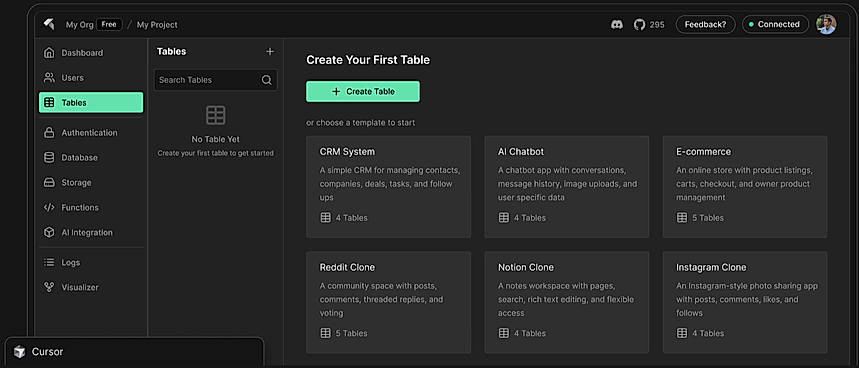
Pricing is one of the first things we check at ICON POLLS, because a great product at the wrong price is still a deal breaker. Here is how InsForge structures its plans as of April 2026.
Free Tier
InsForge offers a free plan that is genuinely usable for prototypes, side projects and learning. You get access to a Postgres database, auth, storage and edge functions with reasonable limits. The self hosted version is also completely free under Apache 2.0, which means you can run the full platform on your own server forever without paying a cent.
Pro Plan
The Pro plan starts at around $25 per month. This tier is aimed at production apps and includes more compute, AI model credits and higher quotas across the platform. The Model Gateway is billed at cost with zero markup, which is a nice touch when you are calling expensive LLMs at scale.
Enterprise
There is a custom Enterprise plan for teams that need dedicated infrastructure, SLAs, security reviews and direct support. Pricing is on request, which usually means it depends on usage and seats.
Overall, InsForge sits in the same neighborhood as Supabase and Appwrite on price. The free tier is reasonable, the Pro plan is fair, and the zero markup policy on AI tokens gives them a small edge over backends that quietly add a margin on top of OpenAI or Anthropic calls.
InsForge on LinkedIn
On LinkedIn, InsForge keeps a low key but consistent presence at linkedin.com/company/insforge. It is not a huge follower base yet, which makes sense for a startup of this size. Most of the visible activity comes from the founding team rather than a polished marketing engine.
CEO Hang Huang posts regularly about agentic infrastructure, fundraising lessons, the realities of building post Y Combinator and the philosophy behind InsForge. He is candid about the trade offs of being non technical earlier in his career and how that shaped how InsForge approaches developers. CTO Tony Yaowen Chang shares more technical updates, including demos of new features like InsForge Realtime and reflections from his time at Databricks before starting the company.
If you are evaluating InsForge as a buyer, following the founders on LinkedIn is honestly the best way to get a feel for how the team thinks. You will see the roadmap, the wins, and the occasional vulnerable post about running a small startup in a crowded category.
InsForge on Reddit
Reddit is where developers tell the truth, so we looked there too. Conversation about InsForge is still small but growing. You will mostly find it inside threads about Supabase alternatives, agentic coding setups, Cursor backends and MCP servers, rather than a giant standalone subreddit.
The sentiment we picked up is mixed but mostly curious. Developers like the idea of an agent first backend and the published benchmarks, but a few raise fair concerns. Common talking points include: the small team behind the project, whether Supabase will eventually close the gap by improving its own MCP server, the steeper setup curve when self hosting, and the fact that the published benchmarks were run by InsForge themselves on a relatively small set of tasks.
If you are coming from Reddit and looking for a verdict, the honest one is that nobody on the platform is calling InsForge a finished product yet. People see the potential, but it is not the kind of unanimous love you see for older, more proven backends.
InsForge Funding
InsForge is an early stage startup. Public sources put the total funding at roughly $1.5 million to $2 million in pre seed capital. Y Combinator is listed among the backers, alongside 1984 Ventures and MindWorks Ventures. Some sources reference a slightly higher figure around $3.5 million, which suggests there may have been a small extension round, though this is not officially confirmed by the company on its own website.
For context, this is a small round in a category where the giant they are challenging, Supabase, was valued in the billions in 2025. That funding gap is part of the story. InsForge is essentially a five to eight person team trying to define a new sub category (agent native BaaS) before Supabase, Firebase or Vercel decide to ship native agent first features themselves.
The runway question is real. A pre seed round of this size is enough to ship product and prove a thesis, but it is not enough to outspend incumbents on marketing or enterprise sales. Whether InsForge raises a strong seed or Series A in late 2026 will tell us a lot about how investors see the agent native BaaS thesis.
InsForge Alternatives
If you are not sold on InsForge, or you just want to compare options, here are the main alternatives developers consider in 2026.
Supabase: the most popular open source Postgres backend, with a huge community, polished dashboard and a deep extension ecosystem. Better if you want a human first developer experience and a proven track record.
Firebase: Google's classic NoSQL backend. Strong for mobile apps and rapid prototyping, but proprietary and harder to migrate away from.
Appwrite: another open source backend with good Docker self hosting. Simpler than Supabase in some ways, with broad SDK support, but no agent native angle.
Convex: reactive, TypeScript first backend that trades SQL for a different mental model. Loved by some teams, niche for others.
Nhost: GraphQL first Postgres BaaS, useful if your stack is built around GraphQL clients.
Encore: gives you a full backend that deploys to your own AWS or GCP account, good for teams that want full ownership of infrastructure.
Xano: no code friendly backend with a visual API builder, popular with non technical founders.
InsForge competes most directly with Supabase. The honest comparison is that Supabase is more mature, more documented and more battle tested, while InsForge has a sharper agent native architecture and better token efficiency when AI agents are doing the work. Many developers we read about end up using both.
InsForge Docs and Documentation Quality
InsForge maintains its official documentation at insforge.dev/docs along with the GitHub repository. The docs cover installation through Docker Compose, one click deployment options on Railway and Zeabur, MCP server setup, database operations, authentication, storage, edge functions and the model gateway.
Quality wise, the docs are clean and well organized for a product this young. There are walkthroughs for connecting Cursor and Claude Code, sample projects, and an llms.txt file that AI agents can read directly. That last detail is a nice touch and very on brand for an agent native platform.
Where the docs still feel thin compared to Supabase or Firebase is in the long tail. Niche topics, edge cases, performance tuning and complex production scenarios are not as deeply covered. If you hit something unusual, you will probably end up in their Discord or reading the source code on GitHub. The team is reportedly responsive on Discord and email, but it is not the same as having a decade of community blog posts to fall back on.
InsForge User Experience
This is the section where we have the most reservations, and a big reason our final rating settled at 2.9 out of 5.
What works well
If you are using an AI coding agent, the experience is genuinely pleasant. You point Cursor or Claude Code at your InsForge instance, the agent reads the schema and capabilities through the MCP server, and it can scaffold tables, set up auth, deploy functions and connect storage from a single prompt. For developers who already live inside their AI editor, this removes a real annoyance: bouncing between code, dashboards and docs.
The dashboard at localhost:7130 is clean, the deployment story is solid for a young product, and the open source license means you are never trapped.
What feels rough
If you are not using an AI coding agent heavily, a lot of the magic disappears. The platform is optimized for agents first and humans second, which is intentional but limiting. Manual configuration through the dashboard is functional but less polished than what you get from Supabase or Firebase.
Self hosting setup has been called out by users as more complex than expected, which is part of why the team built the cloud version. The community is small, tutorials are sparse compared to mature alternatives, and you may find yourself reading the source to answer questions that would be a quick Google search for Supabase.
Reliability and edge cases are still being worked out. The product hit a 2.0.8 release in April 2026, which is a good sign of momentum, but it also means features are landing fast and behaviors can change between versions. For a hobby project that is fine. For something paying the bills, you will want to test carefully and probably stay close to the team.
Our overall feel
InsForge feels like a product with a clear and interesting thesis, a small but talented team, and a roadmap that is racing to keep up with its own ambition. It is exciting to use when it works, and a little frustrating when it does not. That is exactly what an early stage product is supposed to feel like.
ICON POLLS Verdict and Rating
Final Score: 2.9 / 5
InsForge is an interesting and well intentioned product attacking a real problem. AI agents really are bad at backends, and someone needs to build infrastructure for them. The architectural bet is sound, the founders are credible, and the open source approach is the right move.
That said, 2.9 reflects where the product actually is today, not where it might be in twelve months. The ecosystem is small, the docs are thin in places, the team is tiny next to its competitors, the published benchmarks are self reported, and the user experience is mostly delightful only if you are deep into AI coding. We would happily revise this rating upward as the product matures, the community grows and independent benchmarks confirm the performance claims.
If you are an AI native developer, a startup hacking on agentic apps or someone who enjoys early stage tools, InsForge is worth a serious look. If you are running a production backend for paying customers and you want boring reliability, stick with Supabase or Firebase for now and watch this one closely.
Frequently Asked Questions About InsForge in 2026
1. What is InsForge and what does it actually do?
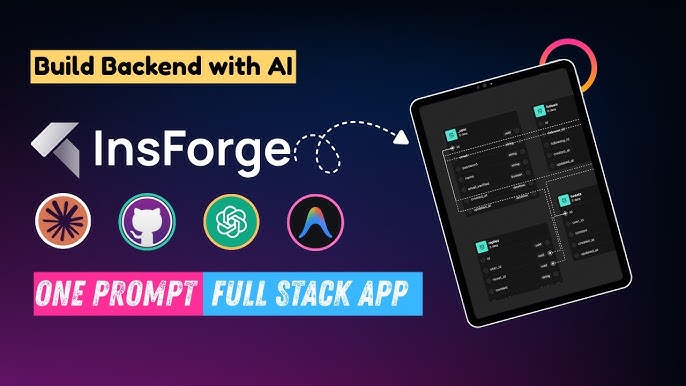
A: InsForge is an open source backend platform built for AI coding agents. It gives agents like Cursor, Claude Code, Windsurf and Lovable a full backend (Postgres database, authentication, storage, edge functions, model gateway and Stripe integration) that they can configure and operate on their own through an MCP server, instead of forcing developers to wire everything by hand.
2. How much does InsForge cost in 2026?
A: InsForge has three tiers. The free plan is enough for prototypes, side projects and self hosted use under Apache 2.0. The Pro plan starts at around $25 per month and is aimed at production workloads with more compute and AI credits. Enterprise pricing is custom. The Model Gateway is billed at cost with zero markup.
3. Who founded InsForge and where is it based?
A: InsForge was founded in 2025 by Hang Huang (CEO, formerly an Amazon product manager) and Tony Yaowen Chang (CTO, formerly at Databricks). The company is headquartered in Seattle, Washington, with team members across the wider San Francisco and Seattle area.
4. How much funding has InsForge raised?
A: Public sources report InsForge has raised roughly $1.5 million to $2 million in pre seed funding, with Y Combinator, 1984 Ventures and MindWorks Ventures listed as backers. Some sources reference a slightly higher figure around $3.5 million, which would point to an extension, though this is not confirmed on the company website.
5. Is InsForge open source and can I self host it?
A: Yes. InsForge is licensed under Apache 2.0 and the full source code is available at github.com/InsForge/InsForge. You can self host using Docker Compose, deploy in one click on Railway or Zeabur, or use the managed cloud version at insforge.dev.
6. Is InsForge better than Supabase?
A: It depends on who is doing the work. If AI agents are building and operating your backend, InsForge has a real advantage thanks to its MCP first architecture and better token efficiency. If humans are configuring everything by hand, Supabase is more mature, more documented and more battle tested. Many teams use both side by side.
7. Which AI coding tools work with InsForge?
A: InsForge integrates with any MCP compatible AI coding agent. The most commonly used ones in 2026 are Cursor, Claude Code, Windsurf, Lovable and similar agentic tools. Setup involves running the InsForge MCP server and pointing your AI tool at it.
8. Is InsForge production ready?
A: It is being used in production by early adopters, but it is still a young product. Releases are landing fast and the ecosystem around it is small. For mission critical workloads we recommend testing carefully, staying close to the team on Discord and being prepared to read source code when something unusual breaks.
9. What are the main downsides of InsForge today?
A: The biggest weaknesses are a small team and ecosystem, sparse third party tutorials, documentation that is thin in places, self hosting complexity that can frustrate first time users, and benchmarks that are run by InsForge themselves. The product is also optimized for AI agents first, so the human dashboard experience is not as polished as Supabase or Firebase.
10. Where can I follow InsForge updates?
A: The best places are the official site insforge.dev, the GitHub repository at github.com/InsForge/InsForge, the company LinkedIn page, the founders' personal LinkedIn profiles, and the InsForge Discord community. The founders also share regular updates on X about new releases and benchmarks.