|
Omma Brand Profile |
|
|
Product Name |
Omma |
|
Developer |
Spline, Inc. |
|
Category |
AI creative platform / no-code builder (3D, websites, apps, motion design) |
|
Launch Date |
March 24, 2026 |
|
Website |
omma.build |
|
Founder & CEO |
Alejandro Leon |
|
Core Technology |
Parallel AI agents for code, image, and 3D generation |
|
Free Plan |
Yes, 50 credits and 5 chats per month, no card required |
|
Paid Plans |
From $29/month (Professional), plus Max and Enterprise tiers |
|
Supported Inputs |
CSV, JSON, documents, images, videos, 3D assets |
|
Output |
Web, mobile, and XR, exportable via Code API (Vanilla.js, React, Next.js) |
|
Support |
Online, documentation, live online and video training |
|
ICON POLLS Rating |
2.6 / 5 |
What Is Omma?
Omma is an AI creative platform built by Spline, the company already known for its 3D and motion design editor. The pitch is simple enough to fit on a sticker: describe what you want, and Omma builds it. You type a prompt in plain language and the system spits out an interactive digital experience, a 3D scene, a website, an app, a game, even a presentation.
What sets it apart from the dozens of other "AI website builder" tools is the parallel agent setup. Instead of one chatbot working through your request step by step, Omma runs several agents at the same time. One writes code, another handles 3D mesh creation, another does image generation. They work in parallel, which is meant to cut the time from idea to finished product down to minutes. Spline says the platform already serves over three million designers, with teams at Google, Datadog, Robinhood, and UPS using its tools.
On paper it is a genuinely clever idea. Most AI builders give you flat, component based interfaces. Omma is trying to fold 3D, motion, code, and UI into one canvas. The question is whether the real thing lives up to the promise, and that is where things get a little bumpier.
Omma AI: How Good Is It Really?
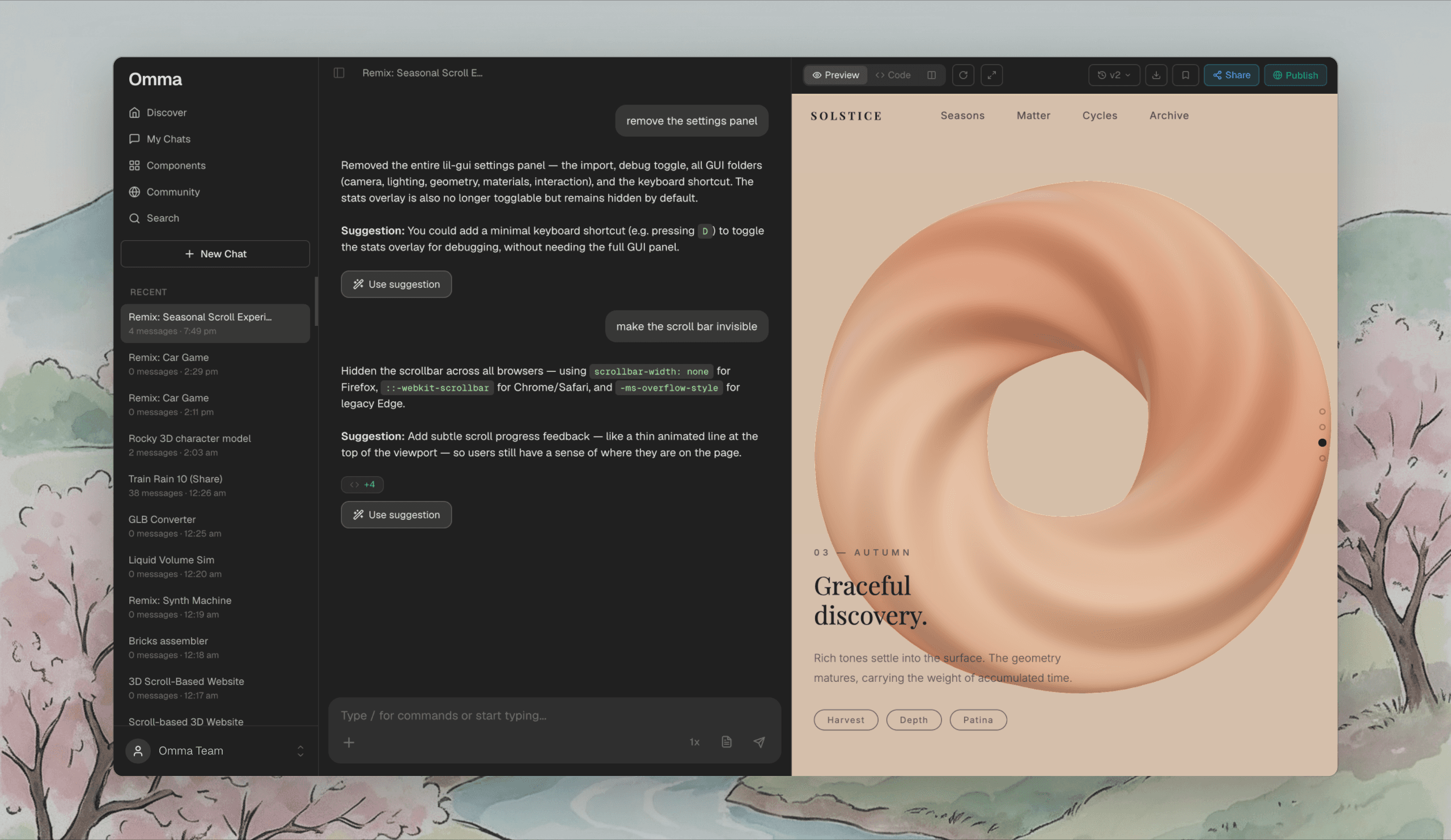
The AI is the whole product, so this is where most of our testing went. The good news is that the parallel agent approach is real and it does feel fast when it works. Asking for a simple landing page with a rotating 3D object gave us something usable within a couple of minutes, and the output was interactive rather than a static mockup. For motion design and 3D specifically, it is genuinely ahead of most competitors because it is built on Spline's existing runtime.
The less good news is consistency. Complex 3D scenes often needed several rounds of re prompting before they looked production ready, and a few times the result drifted away from what we actually asked for. The AI is strong at the flashy first draft and weaker at the precise final ten percent, which is usually the part that matters most. If you are a designer who can jump into Spline's manual editing tools to clean things up, that is fine. If you expected to never touch an editor, you will be disappointed.
Strong at fast first drafts, 3D, and motion design
Parallel agents make generation noticeably quicker than single agent tools
Struggles with precision and consistency on complex scenes
Often needs manual cleanup in the Spline editor to reach production quality
Omma Login and Account Access
Getting into Omma is one of the smoother parts of the experience. You sign up at omma.build, and the free plan does not ask for a credit card, which we always appreciate. Account creation is quick and you are dropped straight into a chat style canvas where you can start describing what you want to build.
Because Omma sits inside the wider Spline ecosystem, your login also connects to Spline's broader account system. We did not run into the kind of broken password resets or locked account complaints that plague some newer platforms, though since the product is only a couple of months old, the long term reliability of the login and account portal is still an open question. For now, access is painless.
Omma Pricing in 2026

Pricing is where a lot of the user frustration shows up, and it weighed heavily on our score. Here is how it breaks down as of 2026:
Free plan: 50 credits and 5 chats per month, no card required. Includes code generation but not image or 3D generation or custom domains.
Professional plan: starts at $29 per month, unlocks image generation, 3D model generation, and custom domains.
Max plan: adds team collaboration features, priced per seat.
Enterprise plan: custom pricing, you contact Spline directly for a demo.
The headline number, $29 a month, sounds reasonable. The catch is the credit system. Every action burns credits, and heavy 3D generation chews through them fast. Several users reported running dry well before the month was over, which means topping up with on demand credits. Unused monthly credits do not roll over, and fees are non refundable. The result is that your real monthly cost can be unpredictable, and for a tool aimed partly at solo creators and small teams, that uncertainty is a real drawback. The free tier, at only 50 credits and 5 chats, is also too thin to do much more than look around.
Omma Portal and Dashboard
The Omma portal is essentially the AI canvas plus your project library. It is clean, modern, and clearly designed by people who care about how things look, which is no surprise given Spline's design pedigree. Projects live in one place, you can remix things shared by the community, and the canvas itself doubles as both the prompt interface and the visual editor.
Where the portal earns real points is the export side. Through the Code API you get programmatic control over your creations, adjusting variables, modifying object properties, triggering transitions, and handling event listeners. Output ships across web, mobile, and XR, with export options for Vanilla.js, React, and Next.js. For developers, that makes the output feel production grade rather than a locked in demo. The main weakness is that the portal assumes a fair amount of comfort with design and 3D concepts, so a complete beginner can feel a little lost despite the friendly marketing.
User Experience
The overall experience is a bit of a split decision. When Omma works, it feels close to magic, and that is not just marketing speak, our team felt it too on a few builds. The conversational workflow is fun, the 3D output is genuinely impressive, and shipping something interactive in minutes is a real thrill.
But the experience gets rough around the edges. The credit anxiety hangs over everything, because you are always half aware that experimenting costs money. Complex requests need patience and re prompting. And the learning curve, while gentler than traditional 3D software, is steeper than the "anyone can do it" pitch suggests. Add the fact that the product is very new, with the usual rough patches that come with a March 2026 launch, and you get an experience that is exciting but not yet dependable. That tension is the single biggest reason our rating sits at 2.6 rather than higher.
Frequently Asked Questions (2026)
1. Is Omma free to use?
Yes, Omma has a free plan that does not require a credit card. It gives you 50 credits and 5 chats per month and includes code generation. However, image generation, 3D model generation, and custom domains are locked behind the paid plans, and 50 credits runs out quickly, so the free tier is best treated as a trial rather than a full version.
2. Who makes Omma and is it legit?
Omma is made by Spline, Inc., an established company already known for its interactive 2D and 3D design editor. It launched on March 24, 2026, and the company says its tools are used by over three million designers, including teams at Google, Datadog, Robinhood, and UPS. So yes, it is a legitimate product from a real, well known company, not a fly by night app.
3. How much does Omma cost?
Paid plans start at $29 per month for the Professional tier. There is also a Max plan priced per seat for teams, and a custom priced Enterprise plan. On top of the subscription, Omma uses credits that can be topped up on demand, so your actual monthly spend depends on how much you generate, especially with 3D.
4. What can you actually build with Omma?
You can build interactive 3D scenes, websites, apps, games, and presentations from plain language prompts. The output is interactive and production ready rather than a static mockup, and it can be exported to web, mobile, and XR, with code export for Vanilla.js, React, and Next.js.
5. Do I need design or coding skills to use Omma?
Not strictly, but they help a lot. The AI handles the heavy lifting and you can get results with zero coding. That said, getting complex projects to a polished, production ready state usually means jumping into Spline's visual editor and understanding some design and 3D concepts, so complete beginners may find it harder than the marketing suggests.
6. Why do Omma credits run out so fast?
Omma charges credits for each AI action, and different operations cost different amounts. 3D generation is especially credit hungry, so heavy users often exhaust their monthly allowance early. Unused credits do not roll over to the next month, which is why many people end up buying on demand top ups.
7. How is Omma different from other AI website builders?
The main difference is its parallel agent architecture and its 3D and motion focus. Most AI builders produce flat, component based pages one step at a time. Omma runs several agents at once for code, images, and 3D, and it is built on Spline's 3D runtime, so it is far stronger for interactive and motion heavy work than typical text to website tools.
8. Is Omma worth it in 2026?
It depends on what you need. If you are a designer or small team focused on interactive 3D and motion work, Omma is worth trying and may become a core tool. If you want a cheap, predictable, beginner friendly website builder, the credit costs and learning curve make it harder to recommend right now. ICON POLLS rates it 2.6 out of 5, a promising but still maturing product.
9. Can I cancel or get a refund from Omma?
Omma plans are billed monthly and you can stop a subscription going forward. However, fees are described as non refundable except where the law requires otherwise, and unused credits do not carry over, so it is worth being deliberate about when and how much you buy.