|
Company Name |
Parsewise (Parsewise Ltd.) |
|
Industry |
AI, Document Intelligence, Data Extraction |
|
Founded |
2024 |
|
Founders |
Maximilian Hofer (CEO), Gergely Csegzi (CTO) |
|
Headquarters |
London, United Kingdom |
|
Team Size |
Around 6 employees (as of January 2026) |
|
Funding Raised |
$500K seed round (June 2025) |
|
Notable Backers |
Y Combinator (X25 batch), Oxonian Ventures, Network VC, General Advance, angels from Palantir, OpenAI, McKinsey and Capital Group |
|
Core Product |
AI agents for multi-document processing and risk decisions |
|
Flagship Interface |
Navi, a conversational workspace for document agents |
|
Target Sectors |
Insurance, asset management, life sciences, KYC and AML, underwriting |
|
Website |
parsewise.ai |
|
ICON POLLS Rating |
3.0 out of 5 |
Parsewise and the AI Story
Parsewise sells itself as an AI decision platform, not just another document parser. The difference matters. There are plenty of tools on the market that can turn a PDF into text. Parsewise wants to go further by reading several documents together, comparing them, flagging contradictions, and giving a business user something they can actually act on.
The platform sits on top of what the team calls the Parsewise Data Engine, or PDE. The engine breaks long, scattered document packages into structured fields, links those fields back to the exact source line in the original file, and keeps a record of every step taken. For regulated industries like insurance and KYC work, that audit trail is the whole point. A claims handler or an underwriter cannot use an answer they cannot defend, and Parsewise builds itself around that idea.
In early 2026 the company launched Navi, a chat style interface that lets non-technical users build and run their own AI agents on top of the engine. Instead of writing prompts or training models, a user describes what they need in plain English and the system handles the heavy lifting. This is the layer that most reviewers have been talking about, because it is the one a normal business user actually touches.
Where the AI still feels rough is in transparency around confidence scores. Reviewers on Product Hunt have pointed out that they want more visibility into why an agent reached a particular answer, especially in legal and financial workflows. The product handles structured extraction well, but the reasoning layer is still maturing.
Parsewise on LinkedIn
If you spend any time on LinkedIn in the AI infrastructure space, the Parsewise team is hard to miss. The founders, Maximilian Hofer and Gergely Csegzi, post regularly, and so do team members like Shan Singh and Nishant Dash. The tone is less polished marketing and more working notes from people who are actively building.
Recent posts have covered the launch of Navi, the Parsewise Labs announcement, the API release on Product Hunt, partnership news with Databricks, and customer case studies. One post mentioned that brokers using Parsewise had cut document review time from three to four hours per applicant down to under an hour. Another talked candidly about the difference between the 80 percent of AI document tools that look great in a demo and the 20 percent of cases where complex real world files break them.
The company also uses LinkedIn as a recruiting channel. Job posts for the London office are shared by the founders themselves rather than through a faceless HR account, which gives the page a startup feel that some readers will appreciate and others will find a bit too founder driven.
Careers at Parsewise
Parsewise hires through the Y Combinator Work at a Startup platform and its own site. As of mid 2026, the team is small, with around six people listed on Tracxn and the YC profile. Open roles have included a Founding Engineer, a Forward Deployed Engineer and a Founding GTM hire, all based in Central London and almost all in person.
Salaries for the public listings have sat in the £60K to £80K range with equity, which is competitive for an early stage YC company in London but not eye watering by big tech standards. The founders have made it clear that they want ambitious, technical, and pleasant people to work with, and the in-person requirement signals that they value a tight, fast-moving office culture rather than a distributed setup.
The backgrounds the team likes to highlight tell you a lot about who fits in. Max came from Bain and ran data science consulting alongside a PhD at Oxford. Greg built early production AI use cases at Palantir across life sciences and insurance. Investors and angels include people from Palantir, OpenAI, McKinsey and Capital Group. If you want to work somewhere that takes enterprise data problems seriously and is happy to bring in opinionated engineers, the profile fits. If you want a remote first job or a sprawling team with deep specialisation, this is not it.
Parsewise Labs
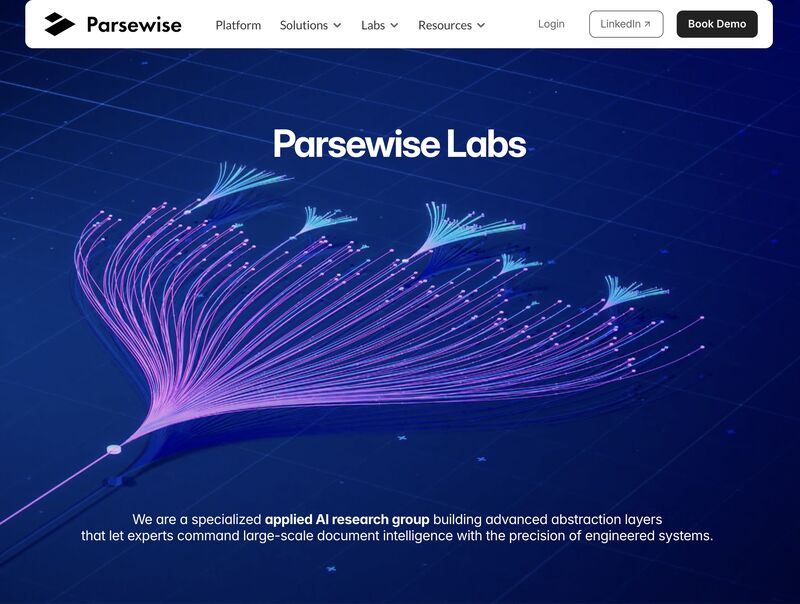
Parsewise Labs was introduced in late 2025 and early 2026 as the company's applied research arm. It is the wing of the business that works on the deeper technology underneath the product, including the Parsewise Data Engine, the risk ontology models, and the abstractions that let domain experts control AI agents with the precision of an engineering system.
The Labs page on the Parsewise site frames the work as building modular, governable components for enterprise grade AI. In practice that means research into how to make agentic systems behave reliably at scale, how to handle traceability across thousands of documents, and how to give compliance teams a system they can actually trust during an audit.
For a company with six people, having a Labs arm at all is ambitious, and some industry watchers see it as positioning rather than a separate org. That said, the technical posts shared by the team suggest there is real research happening, even if it is closely tied to product work right now. The Labs effort is worth watching, but it is not yet at the scale of a true independent research group.
User Experience
The user experience question splits into two parts. There is the developer experience for teams using the API, and there is the business user experience inside Navi and the broader workspace.
Developer side
Developers can pass in multiple input documents, define a desired output structure, and get back resolved values with full lineage across documents and pages. Bounding boxes are returned so engineering teams can build their own viewing layer. Supported formats include PDF, Word, Excel, PowerPoint, and common image types. Documentation lives at docs.parsewise.ai and covers Python SDK examples, authentication, and endpoint details. Reviewers have called the API surface clean, although smaller teams have flagged that some advanced features are still gated behind enterprise plans.
Business user side
Navi is the front door for non-engineers. The interface lets a user upload documents, ask questions in plain language, and get answers with citations back to the source files. The signup is free and does not require a credit card, which is rare for enterprise tools and lowers the barrier for a first try. The Context Graph behind Navi tracks every agent and human decision, which is useful for teams that need to show their working.
Where things slow down is processing speed on large packages. Some user comments have noted that big batches can take a while to run, which is expected for a system that is verifying values across many documents rather than just extracting them. The team has been transparent about this trade off.
Independent trust signals are mixed. The Bilarna AI Trust Index gave Parsewise an aggregate score of 60 percent in January 2026, which puts it in the credible but not yet polished bracket. For a company that is only two years old, that is fair, but anyone evaluating Parsewise for production use should expect the experience to keep changing.
ICON POLLS Verdict on the Experience
What works
Clear focus on multi-document workflows, not just single file parsing
Source-level traceability built into every output
Navi makes the platform accessible to business users without code
Free signup, no credit card required for early evaluation
Founders and team are visible, responsive, and clear about trade offs
What could be better
Confidence scoring and reasoning transparency are still developing
Processing speed on very large document sets can be slow
Small team means support depth is limited for big enterprise rollouts
Some features sit behind enterprise plans that smaller teams cannot easily access
The company is young, so long term reliability is still being proven
Frequently Asked Questions About Parsewise
1. What does Parsewise actually do?
Parsewise is an AI decision platform that reads large packages of business documents, extracts the data inside them, checks for contradictions, and links every value back to its source. It is used most often in insurance underwriting, claims, KYC and AML work, asset management diligence, and life sciences workflows.
2. Who founded Parsewise and where is it based?
Parsewise was founded in 2024 by Maximilian Hofer and Gergely Csegzi. The company is based in London in the United Kingdom and joined the Y Combinator X25 batch.
3. Is Parsewise free to try?
Yes, signing up for Parsewise through Navi is free and does not require a credit card during early evaluation. Larger features and higher volume processing sit on enterprise plans that the sales team prices on request.
4. Is Parsewise safe to use for regulated workflows?
Parsewise has been built around source-level traceability, encryption, and GDPR compliance, and it markets itself to regulated industries like insurance and financial services. The Bilarna AI Trust Index gave it a 60 percent trust score in January 2026, which is solid for a young company but not a substitute for a proper internal security review.
5. How is Parsewise different from generic AI tools like ChatGPT or Claude?
Generic chat assistants can read a document, but they do not handle structured extraction across many documents at once, do not link answers back to specific source lines reliably, and do not keep a defensible audit trail. Parsewise focuses on those three problems and offers an MCP integration so tools like Claude can work at scale through the Parsewise pipeline.
6. Is Parsewise hiring?
Yes, Parsewise has been hiring through Y Combinator and its own site, mainly for engineering and go to market roles in Central London. The roles are typically in person, with salaries that sit in the £60K to £80K range plus equity for early hires.
7. What is Parsewise Labs?
Parsewise Labs is the applied research arm of the company. It works on the Parsewise Data Engine, risk ontology research, and the underlying technology that powers the product. The Labs effort is closely tied to product work today rather than being a fully independent research group.
8. How much funding has Parsewise raised?
As of 2026 Parsewise has raised around $500K in a seed round closed in June 2025. Investors include Y Combinator, Oxonian Ventures, Network VC, General Advance and angel investors from Palantir, OpenAI, McKinsey and Capital Group.
9. Does Parsewise integrate with other enterprise tools?
Yes, Parsewise has announced partnerships such as becoming a Databricks Technology Partner, meaning outputs from underwriting, claims and diligence workflows can land directly in a customer's lakehouse. It also offers a Python API and an MCP integration for use with other AI assistants.
10. Is Parsewise worth using in 2026?
For teams that spend hours reading and cross-checking complex documents in insurance, finance, life sciences or compliance, Parsewise is worth a serious trial. It will not replace a deep enterprise platform overnight, but it does cover real ground that older OCR tools and generic chat assistants miss. ICON POLLS rates it 3.0 out of 5, a respectable score for a young but promising platform.