
Quick Verdict
Stripe in two thousand twenty-six is the dominant payment processor for software companies and developers but a three point five rating reflects that it serves developer-first businesses exceptionally well while frustrating traditional merchants. Stripe processed one point nine trillion dollars in payments globally last year. Half of Y Combinator companies run on Stripe. OpenAI and Anthropic use it for billing. The developer experience is genuinely exceptional with clean APIs, comprehensive documentation, and modular products you can layer as you grow. Stripe Express eliminates merchant onboarding friction. Stripe Live handles in-person payments. The dashboard is intuitive for technical users. The free tier is genuinely free with no setup fees. However, merchant reviews tell a different story. Account verification processes are invasive. Sudden account closures happen with minimal warning. Reserve policies restrict cash flow unpredictably. Customer support response times are slow. International fees are steep. For merchants hitting Stripe's risk engine, satisfaction drops to one point eight out of five. The honest truth is that Stripe prioritizes developer experience and SaaS workflows over merchant experience and omnichannel retail. Understanding this positioning matters before committing.
At a Glance: Icon Polls Ratings
Here's how Stripe scored across what we evaluated in 2026:
|
Category |
Stars |
Score |
|
Developer Experience and API Design |
★★★★★ |
4.5/5 |
|
Dashboard Usability |
★★★★☆ |
4/5 |
|
Documentation and Learning Resources |
★★★★★ |
4.5/5 |
|
Pricing Transparency |
★★★☆☆ |
3/5 |
|
Customer Support Quality |
★★★☆☆ |
2.5/5 |
|
Merchant Account Experience |
★★★☆☆ |
2.5/5 |
|
Global Payment Support |
★★★★☆ |
4/5 |
|
Overall |
★★★★☆ |
3.5/5 |
What Is Stripe?
Stripe is a payment processing platform founded in two thousand ten that enables businesses to accept online and in-person payments globally. The platform processes payments for subscription services, e-commerce stores, and marketplaces. Stripe collapsed what historically required a gateway, merchant account provider, and multiple acquiring banks into a single integrated layer. Developers integrate using REST APIs or pre-built UI components. The platform supports over one hundred thirty-five currencies and local payment methods worldwide. Stripe expanded beyond core payments to include Billing for subscriptions, Tax for sales tax and VAT, Invoicing, Radar for fraud detection, Connect for marketplace platforms, and Terminal for in-person payments. In two thousand twenty-six, Stripe added the Agentic Commerce Suite for AI agents, LLM token billing for model consumption tracking, and Tempo stablecoin settlement capabilities.
Sign-Up and Account Creation
Creating a Stripe account takes about ten minutes. Visit stripe.com and click sign up. You enter your email, create a password, and verify your account. You provide basic business information. Tax ID verification happens automatically for most users. The onboarding walks you through connecting your bank account for payouts. After verification you can immediately accept payments in test mode. Switching to live mode requires additional verification including document review. For most straightforward small businesses, approval is fast. For higher-risk industries or large transaction volumes, verification takes longer and may require extensive documentation. The free account model is genuinely free with no monthly fees or minimums.
Login and Dashboard Access
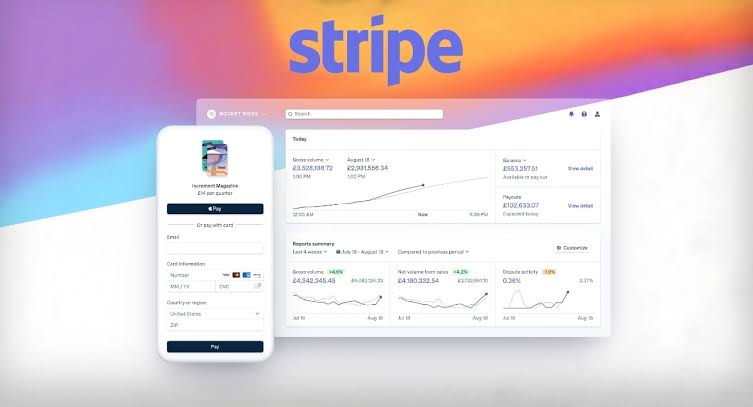
Logging into Stripe is simple. You enter your email and password or use two-factor authentication for security. After login you land in the Dashboard which is the central control panel for managing all payments. The dashboard displays your monthly volume, recent transactions, payouts, and key metrics at a glance. Navigation is logical with sections for Payments, Customers, Products, Invoices, Balance, and more. The interface is clean and modern. Task navigation is straightforward for most common operations. Advanced features like custom API configuration or marketplace setup require more exploration. The dashboard loads quickly and remains responsive. Search functionality helps you find specific transactions or customers. Overall the experience is pleasant for developers but can feel overwhelming for non-technical users encountering complex configuration options.
Free Tier and Pricing
Stripe is genuinely free to start with no setup fees, monthly fees, or hidden charges. You only pay when transactions succeed. The base rate for US card payments is two point nine percent plus thirty cents per transaction. International cards add one percent. Currency conversion adds another one percent. The free tier includes test mode letting you develop and experiment without paying. You pay nothing until going live. This is genuinely excellent for startups and experimentation. However, the free tier becomes expensive as you add products. Stripe Billing for subscriptions adds zero point seven percent. Stripe Tax adds zero point five percent per transaction. Stripe Invoicing adds zero point four percent per paid invoice. For a typical SaaS company, the real effective rate becomes four point five percent instead of the advertised two point nine percent.
|
Feature |
Rate |
When You Pay |
|
Card Processing |
2.9% + 30 cents |
Every successful card charge. |
|
International Cards |
+1% |
Charges from non-US card issuers. |
|
Currency Conversion |
+1% |
Multi-currency or cross-border transactions. |
|
Billing (Subscriptions) |
+0.7% |
Recurring subscription charges only. |
Is The Pricing Fair?
The headline two point nine percent is fair and competitive with Square and PayPal. The problem is the hidden math. Adding Billing, Tax, and Invoicing for a typical SaaS business increases effective rates to four point five percent. International businesses face aggressive FX markups at one to two percent compared to zero point six percent with competitors like Revolut. For high-volume businesses, custom pricing negotiations are possible but require ten million dollars plus annual volume. Most small and medium businesses pay the standard rates without negotiating power.
Stripe Express and Onboarding
Stripe Express is a game-changer for marketplace and platform businesses. Instead of onboarding complex merchant requirements, Express lets platforms collect essential information and have Stripe handle the rest. Merchants sign up with minimal friction. Express accounts cost two dollars monthly per active account plus zero point twenty-five percent plus twenty-five cents per payout. For platforms abstracting payment complexity, Express justifies the cost by eliminating merchant support burden. The merchant experience is dramatically simpler than traditional Stripe integration. This is one of Stripe's clearest innovations.
Dashboard and Live Mode
The Stripe Dashboard provides comprehensive visibility into your payment operations. Live mode shows real transactions. Test mode is a sandbox for development. You can issue refunds directly from the dashboard. Create invoices on the fly. View detailed transaction data. Set up webhook notifications for events. Configure global settings. The dashboard includes a Terminal interface for in-person payments. A Reports section provides analytics. Radar shows fraud signals. The experience is clean and mostly intuitive. However, navigating to less common features requires exploration. The more complex your setup, the more technical knowledge you need.
Technology and Platform Architecture
Stripe's technology is exceptional. The platform processes payments through its own infrastructure with multiple layers of redundancy. PCI DSS Level One certification means your servers never touch card data. Stripe handles encryption and tokenization. Webhook architecture integrates events into your backend asynchronously. The API is REST-based with comprehensive documentation. Client libraries exist for most programming languages. Test mode lets you simulate every scenario before going live. The underlying technology scales to handle massive transaction volumes. Amazon, Google, and OpenAI trust Stripe's infrastructure.
Pros and Cons
What Works Excellently
Developer experience is exceptional with clean APIs and comprehensive documentation
No setup, monthly, or hidden fees for starting free accounts
Global payment support across one hundred thirty-five plus currencies
Modular products let you add features as you grow without switching platforms
Dashboard is intuitive for tracking transactions and managing operations
Express eliminates merchant onboarding burden for platforms
Terminal provides flexible in-person payment processing
Test mode allows full development without payment fees
Webhook architecture integrates naturally with backend systems
PCI compliance handled means you avoid cardholder data burden
What Needs Improvement
Account verification process is invasive with extensive documentation required
Sudden account closures happen with minimal explanation or recourse
Reserve policies restrict cash flow for new accounts unpredictably
Customer support response times are slow especially for merchants
International and FX fees are aggressive compared to alternatives
Pricing becomes non-transparent when adding Billing and Tax products
Merchant reviews are significantly lower than developer reviews
Non-technical merchants find setup and configuration challenging
Frequently Asked Questions About Stripe (2026)

1. Is Stripe truly free to start?
Yes, Stripe is completely free with no setup, monthly, or hidden fees. You only pay per successful transaction. Test mode is free forever. You can build and experiment at zero cost.
2. How long does account verification take?
Verification typically takes one to two business days for straightforward businesses. High-risk industries or unusual business models take longer requiring additional documentation. Some accounts require weeks of review.
3. Can Stripe close my account?
Yes, Stripe reserves the right to close accounts that violate terms or present excessive risk. Closures sometimes happen with limited explanation. Merchants have reported sudden closures over account reserves or transaction patterns. This is a real frustration point.
4. What are Reserve Policies?
Stripe may place reserves on account balances to cover potential chargebacks or refunds. For new accounts this can be substantial. Reserves may remain for months even if disputes never materialize. They restrict your access to earned revenue.
5. How much does it cost to add Billing and Tax?
Stripe Billing adds zero point seven percent per recurring charge. Stripe Tax adds zero point five percent per transaction. These stack on top of base payment processing fees increasing effective rates significantly.
6. Does Stripe handle international payments?
Yes, Stripe supports one hundred thirty-five plus currencies and local payment methods worldwide. However, international transaction fees add up to three percent including card fees and currency conversion markups.
7. Is Stripe Express worth the cost?
For platforms and marketplaces, yes. Express eliminates complex merchant onboarding saving significant support costs. For simple businesses, standard integration is more cost-effective.
8. How does Stripe compare to PayPal?
Stripe has better developer experience and APIs. PayPal has better merchant tools for non-technical users. Pricing is comparable at base rates but Stripe's add-on fees add up faster. PayPal is simpler for small merchants.
9. Do I need a separate merchant account?
No, Stripe handles the full merchant account function. You connect your bank account directly to Stripe. Funds are deposited on a fixed schedule. No third-party merchant account provider needed.
10. Should I use Stripe or an alternative?
Use Stripe if you are a developer-first SaaS company processing card payments. Use Revolut if you process significant international volume. Use PayPal if you prefer merchant simplicity. Use Square if you blend online and POS. Choice depends on your specific shape.
Icon polls Verdict
Stripe earns a three point five out of five. That rating reflects a platform that excels for developers and software companies but frustrates traditional merchants. The developer experience is exceptional. The documentation is comprehensive. The API is elegant. The pricing is transparent at headline rates. Global support is genuine. For SaaS businesses, startups, and platforms, Stripe is often the right choice.
The three point five reflects that merchant experience differs significantly. Account verification is painful. Support is slow. Reserve policies restrict cash flow. Sudden account closures happen. International fees are steep. For merchants facing Stripe's risk engine, satisfaction drops significantly. The honest positioning is that Stripe optimizes for developers accepting that tradeoff for merchant experience.
The practical recommendation is if you are building software and need embedded payments, Stripe is genuinely excellent. If you are a merchant primarily, evaluate PayPal or Revolut. If you operate internationally, calculate Stripe's FX costs carefully against alternatives. Understand what you are getting and what you are giving up before committing.