|
Tines Company Profile |
|
|---|---|
|
Company Name |
Tines |
|
Founded |
2018 |
|
Founders |
Eoin Hinchy (CEO) and Thomas Kinsella (CCO) |
|
Headquarters |
Dublin, Ireland and Boston, Massachusetts (co-HQ) |
|
Industry |
Cybersecurity, Workflow Automation, SOAR |
|
Product Category |
No-code intelligent workflow and AI agent platform |
|
Total Funding Raised |
$272 million across six rounds |
|
Latest Round |
Series C, $125 million, February 2025 |
|
Lead Investor (Series C) |
Growth Equity at Goldman Sachs Alternatives |
|
Other Notable Investors |
SoftBank Vision Fund 2, Accel, Felicis, CrowdStrike Falcon Fund, Activant, Addition |
|
Current Valuation |
$1.125 billion (unicorn status) |
|
IPO Status |
Privately held, no IPO announced as of 2026 |
|
Employee Count |
Approximately 250 (2026) |
|
Key Customers |
Coinbase, Databricks, GitLab, Mars, McKesson, Reddit, SAP, Canva, Elastic, Dropbox, Intercom |
|
Pricing Model |
Free Community Edition; paid tiers with custom enterprise pricing |
|
Certifications |
SOC 2 Type II, ISO 27001, ISO 42001, GDPR, CCPA |
|
Public Rating (G2) |
4.7 out of 5 from over 400 reviews |
|
ICON POLLS Rating |
3.9 out of 5 |
|
Official Website |
www.tines.com |
Tines Review in 2026: What the Platform Actually Does
Tines is a no code intelligent workflow platform built mainly for security and IT teams. The product was launched in 2018 by Eoin Hinchy and Thomas Kinsella, two former security engineers who had previously worked at DocuSign and eBay. They were tired of writing throwaway Python scripts to glue tools together inside a SOC, so they built Tines as a visual way to do the same thing without code.
In Tines, you build what the company calls a story. A story is a chain of building blocks (called actions) that move data between systems, make decisions, call APIs, and pause for human approval when needed. By 2026 the platform supports thousands of integrations and now includes native AI agents, a chat style interface called Workbench, and a natural language builder called Story Copilot that was rolled out in February 2026.
In short, this is not just a SOAR tool anymore. It has grown into a general purpose automation layer that some IT, engineering, legal, and even HR teams are starting to use. But security is still the heart of it, which is why we want to spend a bit of time on the SOC angle.
Tines AI in 2026
AI is where Tines has put the most muscle this year. The native AI agents that launched in June 2025 are now embedded across the entire platform, and the experience is honestly quite slick. Inside a story you can drop in an AI agent block, give it a plain English instruction, scope which tools it can use, and let it run. Crucially, you can still bolt on deterministic logic and human in the loop checkpoints around the agent, which is what enterprise security teams keep asking for.
A few things impressed us during testing. The platform runs AI entirely within Tines own infrastructure and scopes it to a single tenant, so customer data never leaves the boundary, is not logged, and is not used to train external models. For SOC 2, HIPAA, or PCI DSS shops, that is a real selling point. Tines also picked up ISO 42001 certification, which is the international standard specifically for AI management systems, and not many vendors have that yet.
Story Copilot is the other piece worth mentioning. You describe what you want the workflow to do in natural language, and the Copilot drafts the story for you. It does not always nail it on the first try, but for getting a v1 onto the canvas it saves real time. The Workbench chat interface also lets analysts query data and trigger actions across connected apps without leaving a single window.
Where the AI story still has gaps: a few customer reviews mention that agentic workflows can hit cost ceilings quickly on larger jobs, and that observability into what the agent did and why could be better. Both are areas Tines has said it is investing in.
Tines for SOC Teams
The SOC is where Tines truly shines, and that comes through in every review we read. Customers like Netskope have publicly said they tripled SOC efficiency without adding headcount, cut MTTR by 25 percent, and now automate the equivalent of one analyst per week using Tines. McKesson described it as a strategic tool sitting on their automation and AI pillar.
From a hands on perspective, building a typical SOC playbook in Tines feels quick. Phishing triage, alert enrichment, IOC sweeps, identity revocation, and ticket creation are the kinds of workflows that snap together fast. The library of native connectors covers most of the SOC stack: CrowdStrike, SentinelOne, Splunk, PagerDuty, Okta, Jira, ServiceNow, Slack, and many more. And if a tool is not natively supported, the HTTP request block lets you hit any REST API.
There are some pain points worth noting. A few SOC users on Gartner Peer Insights flagged that documentation is thin for advanced use cases, that debugging long stories can be painful, and that workflow versioning is not as mature as something like GitHub. The platform also struggles a little when you push very large data volumes through a single story. None of these are deal breakers, but they are real considerations for big teams.
The Tines Product
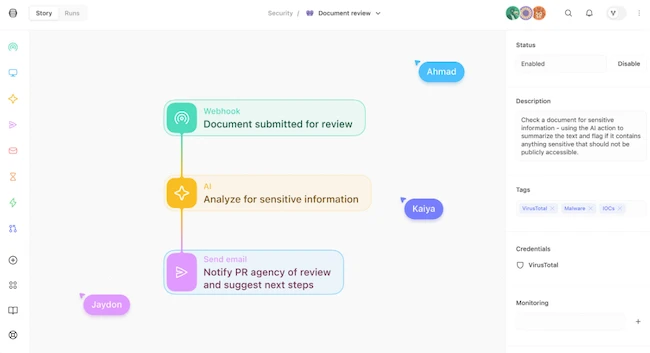
The product itself is a browser based canvas where you drag actions onto a storyboard and connect them. It looks deceptively simple, but underneath it is doing serious work. Some highlights from our testing:
Visual story builder with drag and drop blocks, including triggers, HTTP requests, transforms, AI agents, and human approvals.
Workbench, a generative AI chat layer that lets analysts query data and act on it across connected apps.
Story Copilot, the natural language workflow builder launched in February 2026.
Native MCP (Model Context Protocol) server support across all plans, including the free Community Edition, so AI clients can plug straight into your Tines workflows.
Granular credential management, JIT access, and audit logs for compliance.
Pre built story templates submitted by other customers, which speed up day one productivity.
The free Community Edition is genuinely generous. A single user can build unlimited workflows and even publish MCP servers, which is rare for a product of this caliber. Enterprise pricing is custom and tends to start around $50,000 per year based on third party reports, scaling with team size and feature tier.
Tines University
If you are picking up Tines for the first time, Tines University is where you should start. It is a free, self paced learning platform that anyone can join, and the content is genuinely well produced. Courses are organized into learning paths, each made up of short modules that take about 30 minutes each. There are two main certification tracks: Core and Advanced.
By mid 2024 over 500 users were already certified, and our understanding is that number has grown well past the thousand mark in 2026 as more enterprise teams roll the certification into their L&D plans. Each completed path comes with a digital badge you can share on LinkedIn, which we have actually seen recruiters mention positively when hiring for SOC engineering roles.
Topics covered include the basics of stories, actions, JSON, APIs, and events, then more advanced themes like credentials, resources, functions, and story design. The Tines Training Team grades the lab submissions within 72 hours, which is unusually fast for a free program. Overall we think Tines University is one of the most underrated parts of the offering.
Tines IPO Outlook
This is one of the questions our readers ask the most, so let us be direct. Tines has not filed for an IPO and has not announced one as of 2026. The company is still privately held, with a $1.125 billion valuation set during the Series C in February 2025 led by Goldman Sachs Alternatives.
That said, the conditions are interesting. Tines is now a unicorn, has $272 million in total funding, blue chip investors, and a profitable looking customer base. PitchBook even flags an IPO as one of the plausible exit paths in its models. Realistically though, an IPO before late 2027 or 2028 would be a stretch, especially given how cautious the public markets have been with mid stage software companies. We will keep this section updated as soon as any concrete signal comes from the company.
If you are searching for Tines stock or Tines shares, there is no public ticker. Any platform claiming to offer pre IPO Tines shares should be treated with healthy skepticism.
User Experience
On the user experience front, Tines does most things right and a few things wrong. The visual canvas feels modern, fast, and responsive. The copy paste is native across the whole product, including between tenants, which is a small touch that saves a lot of time. Credentials, both native and custom, are easy to set up. Workbench is genuinely helpful as a debugging companion.
On the rough side, the documentation does have gaps for advanced features. The community Slack and the in app help center are usually quicker than the official docs. Pricing is also not transparent on the website, which means you have to talk to sales for anything beyond the Community Edition. And some users feel the cost can climb fast once you start pushing serious AI agent volume.
Overall, the day to day feel is closer to a polished consumer SaaS product than a typical enterprise security tool. That is rare and worth flagging.
ICON POLLS Final Verdict: 3.9 out of 5
Tines is one of the strongest no code automation platforms we have reviewed this year. It is mature, well funded, secure by design, and clearly listening to its customers. The AI features actually work, the SOC use cases are battle tested, and Tines University lowers the barrier to entry in a way few vendors bother with.
Why not a higher score? Documentation gaps, enterprise pricing that feels opaque, the cost ceiling on heavy AI agent jobs, and the difficulty of debugging really large stories all keep this from being a clean four star product for us. But these are fixable issues, not foundational ones, and Tines has the resources and the focus to address them.
If you are running a security or IT team and you want to stop writing glue scripts and start automating properly, Tines deserves a serious look. The free Community Edition is the perfect place to start.
Frequently Asked Questions About Tines in 2026
1. Is Tines a SOAR platform?
Yes and no. Tines started life as a SOAR (Security Orchestration, Automation, and Response) platform and is still widely used as one. However, in 2026 Tines positions itself more broadly as an intelligent workflow platform that handles security, IT, and general business automation. So if you only need a SOAR, Tines covers it well. If you need broader automation, it does that too.
2. Is Tines free to use?
Yes. The Community Edition is completely free for a single user and includes unlimited workflows, MCP server publishing, and access to most platform features. It is genuinely usable for personal projects, home labs, and small SOC tasks. Paid plans unlock multi user collaboration, advanced governance, premium support, and higher operational limits.
3. When will Tines IPO?
There is no announced IPO date. As of 2026, Tines remains privately held with a $1.125 billion valuation after its $125 million Series C in February 2025. Public listing is one possible exit path according to industry analysts, but nothing has been filed or confirmed. We would not expect anything before 2027 at the earliest.
4. How does Tines compare to Torq, Splunk SOAR, or Palo Alto XSOAR?
Torq is the closest direct competitor and is also a no code security automation platform aimed at mid market SOCs. Splunk SOAR (formerly Phantom) and Palo Alto XSOAR are more traditional, code heavy SOAR platforms that come bundled with their respective SIEM ecosystems. Tines tends to win on ease of use, time to first workflow, and the native AI agent experience. The legacy SOARs win on deep integration with their parent platforms. Choose based on whether your team prefers a flexible standalone tool or a tightly integrated stack.
5. Is Tines safe to use with sensitive customer data?
Tines is widely considered enterprise grade from a security standpoint. It holds SOC 2 Type II, ISO 27001, ISO 42001, GDPR, and CCPA certifications. AI processing happens entirely within Tines own infrastructure, scoped to a single tenant, and customer data is never logged or used for training. Companies handling regulated data like Coinbase, Mars, and McKesson use Tines, which is a strong signal.
6. What is Tines University and is it really free?
Tines University is the official learning platform for Tines users. It is fully free and self paced, with structured learning paths, hands on labs, and two certification tracks (Core and Advanced). When you complete a path and pass the exam, you earn a digital badge you can post on LinkedIn. The training team grades lab submissions within about 72 hours.
7. Who owns Tines and who are the founders?
Tines was founded in 2018 by Eoin Hinchy and Thomas Kinsella, both former security engineers from DocuSign and eBay. Eoin Hinchy is the current CEO and Thomas Kinsella serves as Chief Customer Officer. Major institutional shareholders include Goldman Sachs Alternatives, SoftBank Vision Fund 2, Accel, Felicis, CrowdStrike Falcon Fund, Activant, and Addition.
8. Does Tines support AI agents and how good are they?
Yes. Tines launched native AI agents in June 2025 and they are now a core part of the platform. You can drop an agent into any story, give it natural language instructions, and scope its tool access. Combined with Story Copilot (the natural language workflow builder released in February 2026) and Workbench (the AI chat interface), Tines is one of the more polished agent platforms inside the security automation space. Cost management and observability are the main areas where users still want improvements.
9. What companies use Tines?
Tines is used by a long list of well known brands, including Coinbase, Databricks, GitLab, Mars, McKesson, Reddit, SAP, Canva, Elastic, Dropbox, Intercom, Box, and Netskope. The customer base skews towards companies with large security and IT teams, but smaller startups also use the free tier extensively.
10. Is Tines worth it in 2026?
For most security, IT, and operations teams that want to reduce manual work and bring AI into their workflows safely, our short answer is yes. The free Community Edition removes the risk of trying it out, the certifications and training are top tier, and the platform itself is one of the more mature no code automation tools in the market today. The main things to watch are enterprise pricing and the cost ceiling on heavy AI agent usage. With those considerations in mind, ICON POLLS rates Tines 3.9 out of 5 for 2026.