|
Profile Item |
Details |
|
Full meaning |
You Aren’t Gonna Need It |
|
Category |
Software development and agile design principle |
|
Origin |
Extreme Programming (XP) |
|
Main purpose |
To prevent unnecessary features, speculative code and premature complexity |
|
Common users |
Software developers, product teams, engineers, designers and agile teams |
|
AI relevance in 2026 |
Useful for controlling AI-generated code, feature creep and excessive scaffolding |
|
Official product or brand |
No. YAGNI is a principle, not a single company, app or AI platform |
|
Typical pronunciation |
YAG-nee |
|
Best for |
Teams that need faster delivery, simpler code and clearer product priorities |
|
Main risk |
It can be misused as an excuse to ignore obvious architecture, security or scalability needs |
|
ICON POLLS rating |
2.9 out of 5 |
What Is YAGNI?
YAGNI stands for “You Aren’t Gonna Need It.” It came from Extreme Programming and is closely connected to simple design. The basic idea is that developers should implement what is required now instead of adding features, options or abstractions because they might become useful later.
For example, a team building a small booking system may be tempted to create support for ten languages, five payment providers and several user roles before the first customer has signed up. YAGNI asks the team to pause. If the current requirement is one language, one payment method and two user roles, the extra work may create more bugs and maintenance without delivering immediate value.
YAGNI and AI in 2026

AI coding assistants have made YAGNI more relevant, not less relevant. Modern tools can quickly generate database layers, dashboards, APIs, tests, configuration files and reusable components. That speed can be helpful, but it also makes overbuilding easier. A developer can now produce unnecessary architecture before the team has confirmed that users need the feature.
The best use of YAGNI with AI is to limit the scope of each prompt and review the output carefully. Teams should ask AI to solve the present requirement, explain its assumptions and avoid optional features unless requested. Human review still matters because fast code generation does not guarantee correct, secure or maintainable code.
In practical terms, YAGNI can reduce AI-generated clutter. It encourages smaller pull requests, fewer speculative integrations and less boilerplate. The principle becomes dangerous only when people assume that “not building it now” means “not thinking about it at all.” Good teams still record risks and make reversible design choices.
What Reddit Users Say About YAGNI
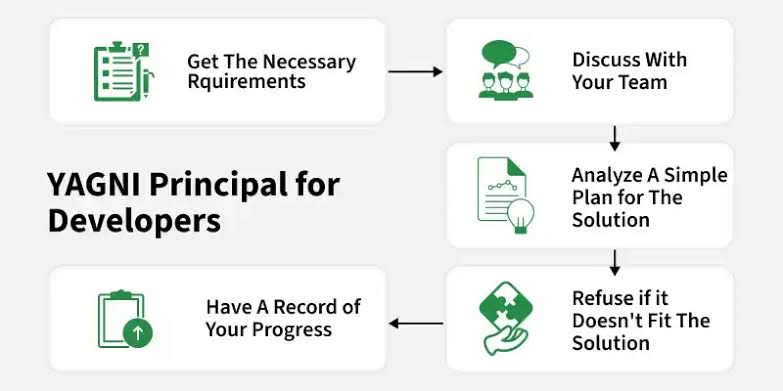
Reddit discussions about YAGNI are usually divided between two views. Supporters say it helps developers finish working products faster and prevents codebases from becoming crowded with abstractions that may never be used. Critics agree with the principle but warn that it is sometimes used as an excuse for weak design.
A common point in experienced developer discussions is that YAGNI should not prevent extensibility. A team does not need to build every future feature, but it should avoid creating a tightly coupled system that becomes impossible to change. This is a fair criticism and one of the main reasons our rating did not go above 2.9.
YAGNI Wiki Meaning and Background
Wiki and software glossary pages generally describe YAGNI as an Extreme Programming principle that discourages adding functionality before it is necessary. It is often discussed beside KISS, DRY, simple design, refactoring and continuous integration.
The wider lesson is not that planning is bad. YAGNI targets speculative implementation. A team may still discuss future needs, document likely risks and design clean boundaries. The warning is against spending time and money building unconfirmed functionality.
How to Pronounce YAGNI
YAGNI is commonly pronounced “YAG-nee.” Some developers simply say each letter, but the word-like pronunciation is more common in informal software conversations. It is an acronym for “You Aren’t Gonna Need It.”
What Does “YAGNI Cold” Mean?
“YAGNI cold” does not appear to be a recognised software term. It is likely a mixed or incomplete search query. Searchers may be combining YAGNI with an unrelated word, looking for a product with a similar name, or trying to compare software principles. There is no established “cold” version of YAGNI in mainstream agile or software engineering references.
YAGNI in Software Development
In software work, YAGNI is most useful during feature planning, architecture discussions and code review. It helps teams ask a simple question: Is this code needed to satisfy a current requirement, or are we building it because we imagine it could be useful one day?
Benefits can include shorter development time, fewer bugs, easier testing and a smaller codebase. It can also improve product focus because teams spend more time on confirmed user problems. On the negative side, a careless interpretation can create repeated rework, technical debt or performance problems when predictable needs are ignored.
YAGNI and User Experience
From a user experience perspective, YAGNI can be positive because it discourages crowded interfaces and unnecessary options. Users often prefer a product that does a few important things clearly rather than one filled with unfinished or confusing features.
Still, product teams should not use YAGNI to dismiss research. If users repeatedly request accessibility, account recovery, better onboarding or clearer navigation, those are real needs. The principle should remove speculative features, not silence customer feedback.
YAGNI Pros and Cons
Advantages
Keeps teams focused on current, confirmed requirements.
Reduces unnecessary code, features and maintenance.
Can lower development cost and shorten delivery time.
Works well with iterative development and regular refactoring.
Helps control excessive AI-generated code and feature creep.
Disadvantages
Can be misunderstood as an instruction not to plan.
May lead to expensive rework when obvious future needs are ignored.
Depends on experienced judgement and good communication.
Can become an excuse for weak architecture or missing documentation.
Offers no detailed process for deciding what is truly necessary.
Why ICON POLLS Rated YAGNI 2.9 Out of 5
ICON POLLS gives YAGNI a 2.9 out of 5 rating. We found that the principle remains practical, memorable and especially relevant in AI-assisted development. It can save time and help teams avoid building features nobody has requested.
The lower score reflects its limitations. YAGNI is not a complete development system, and it does not replace product research, architecture, security planning, testing or professional judgement. When applied without balance, it can move a team from overengineering to underengineering.
Frequently Asked Questions About YAGNI
1. What does YAGNI stand for?
YAGNI stands for “You Aren’t Gonna Need It.” It advises developers not to build functionality until there is a confirmed need for it.
2. Is YAGNI an AI tool or company?
No. YAGNI is a software development principle, not a standalone AI tool, company or consumer application.
3. Is YAGNI still relevant in 2026?
Yes. It is particularly relevant because AI assistants can generate unnecessary code and features very quickly. YAGNI helps teams control scope.
4. How do you pronounce YAGNI?
It is commonly pronounced “YAG-nee.” Some people also spell out the individual letters.
5. What is the YAGNI principle in software?
It means implementing only the functionality needed for current requirements instead of building speculative future features.
6. What do Reddit developers think about YAGNI?
Many developers support its focus on simplicity, while others warn that it should not be used to justify poor architecture or tightly coupled code.
7. What is the difference between YAGNI and KISS?
YAGNI asks whether a feature is needed at all. KISS asks whether the chosen solution is as simple as it can reasonably be.
8. What is the difference between YAGNI and DRY?
YAGNI discourages unnecessary functionality. DRY, meaning “Don’t Repeat Yourself,” focuses on reducing duplicated knowledge or logic.
9. Can YAGNI cause technical debt?
Yes, when it is applied carelessly. Ignoring obvious security, scalability or maintainability needs may create expensive rework later.
10. Does YAGNI mean developers should not plan ahead?
No. Teams can plan, document risks and choose flexible designs. YAGNI mainly warns against implementing unconfirmed features too early.
11. How does YAGNI improve user experience?
It can keep interfaces focused and reduce confusing features. However, it should never be used to ignore verified user feedback or accessibility needs.
12. Is “YAGNI cold” a software concept?
No recognised mainstream software concept is called “YAGNI cold.” It is most likely a mixed, incomplete or unrelated search phrase.