We spent real time inside Customer.io before writing this. We built campaigns, pushed data through the API, went through the documentation end to end, talked to people who use it daily, and paid attention to where it genuinely works and where it quietly frustrates you. This review is the honest result of all of that.
Customer.io is not an email marketing tool in the traditional sense. Calling it that would be like calling a Swiss Army knife a bottle opener. At its core, it is a behavioral messaging platform that lets you trigger communication across email, SMS, push notifications, in-app messages, and WhatsApp, all based on what users actually do inside your product. If that sounds like what you need, read on. If you just want to send a newsletter, there are simpler tools for that.
Customer.io 2026 Quick
|
Product |
Customer.io |
|
Founded |
2012 |
|
Headquarters |
Portland, Oregon, USA (fully remote-first company) |
|
Type |
Multi-channel customer engagement and lifecycle messaging platform |
|
Essentials Plan |
$100 per month (up to 5,000 profiles) |
|
Premium Plan |
$1,000 per month (advanced compliance, dedicated CSM) |
|
Enterprise Plan |
Custom pricing (contact sales) |
|
Free Trial |
14 days, up to 5,000 messages across all channels |
|
Startup Program |
Free 12-month access for companies that have raised under $10M |
|
Channels Supported |
Email, SMS, push notifications, in-app messages, WhatsApp, webhooks |
|
API |
REST API with Track and Pipelines endpoints; billions of daily calls processed |
|
Icon Polls Rating |
4.0 out of 5 |
Icon Polls Ratings Breakdown
Here is how Customer.io scored across twelve categories based on our testing and research.
|
Category |
Score (out of 5) |
|
Company and Product Vision |
4.5 / 5 |
|
Login and Onboarding |
3.5 / 5 |
|
Pricing Transparency |
3.0 / 5 |
|
API Quality |
5.0 / 5 |
|
Documentation |
4.5 / 5 |
|
Automation and Journey Builder |
4.5 / 5 |
|
Multi-Channel Messaging |
4.5 / 5 |
|
Segmentation and Data Model |
4.5 / 5 |
|
Reporting and Analytics |
3.0 / 5 |
|
Career and Company Culture |
4.5 / 5 |
|
Overall User Experience |
3.5 / 5 |
|
OVERALL ICON POLLS RATING |
4.0 / 5 |
Customer.io: The Company Behind the Product
Customer.io was founded in 2012 by Colin Nederkoorn and John Allison in Portland, Oregon. The company describes itself as a customer engagement platform built for tech-savvy organisations that want to create personalised customer journeys at scale. It has raised a total of around 9.13 million dollars, which is relatively modest for a product of this capability, with investors including Spectrum Equity, Dawn Capital, Oregon Venture Fund, and Portland Seed Fund.
The company is fully remote-first and globally distributed, which is a deliberate cultural choice rather than a pandemic legacy. In 2025, Customer.io was named one of the fastest-growing private companies on the Inc. 5000 list, which reflects how far the platform has grown from its early days as a relatively niche tool for developer-led teams. By 2026, it ranked number 13 on the Best Practice Institute's Top 100 Global Most Loved Workplaces list, a ranking based on over 2.8 million employee responses across 20 industries. That is a meaningful signal about what working there feels like.
The product is used by companies including Notion, Pipedrive, Kraft Heinz, and Zara USA, which gives you a sense of the range of teams building on top of it. It serves both product-led growth companies and traditional marketing teams, though it is clearly more natural for the former. ISO certification, SOC Type II, HIPAA compliance at Premium tier, GDPR support, CCPA compliance, and data residency options in either the EU or the US signal that this is a platform built with enterprise-level data requirements in mind.
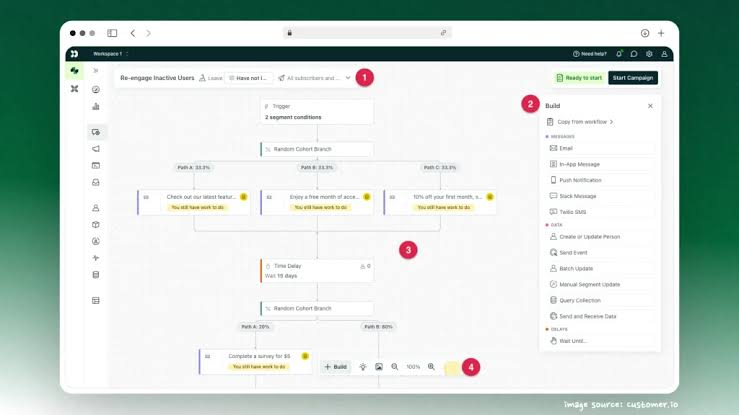
Customer.io Login and Getting Started
Logging in to Customer.io is clean and straightforward. You can sign up directly through customer.io and choose between a 14-day free trial or, if you qualify, the startup program that gives you free access for 12 months if your company has raised less than 10 million dollars. No credit card is required during the trial period, which is always a good sign.
The 14-day trial lets you send up to 5,000 messages across all channels, which is enough to build a real workflow and test the API integration properly. You can send test messages to up to three recipients at a time, with a cap of 50 test messages per day. If you want to trial the Premium features specifically, you need to upgrade to a premium trial version, which requires contacting the sales team.
Once inside, you land in a workspace view. Customer.io uses workspaces to separate environments, so you can run production and staging separately, which is important if you are integrating with a live product. Account admin and billing access are permissions-controlled, which matters for teams where marketing and engineering operate under different access levels.
The honest note here: getting past the login screen and building your first working campaign requires more setup than tools like Mailchimp or ActiveCampaign. You need to either set up the Track API to send user events, use a third-party data pipeline like Segment, or configure a Reverse ETL connection from your data warehouse. For a developer-led team, this is entirely straightforward. For a marketing team working without engineering support, the initial hours can be frustrating.
Customer.io Pricing in 2026: What You Need to Know
Pricing is based on the number of profiles you store in your workspace, not the number of messages you send. This is a meaningful structural choice that works in your favour if you are a high-volume sender, but can work against you if you have a large inactive user base sitting in your account. All profiles count toward your billing total regardless of whether they have engaged recently.
The Essentials plan starts at 100 dollars per month for up to 5,000 profiles. From there, pricing scales with your profile count. At 10,000 profiles you are paying around 150 dollars per month. At 50,000 profiles you should expect to pay around 400 to 500 dollars per month. Email overages beyond plan limits are charged at 0.85 dollars per 1,000 emails.
The Premium plan sits at 1,000 dollars per month and adds features that most Essentials customers do not actually need: HIPAA compliance, 90-day dedicated onboarding support, a dedicated customer success manager, and access to data warehouse integrations that export from Customer.io to Snowflake, BigQuery, Redshift, Amazon S3, and Microsoft Azure. The gap between 100 dollars and 1,000 dollars per month catches a lot of teams off guard when they first look at the pricing page. The jump is real, but the trigger for it is usually HIPAA compliance or scale-specific support needs, not everyday feature access.
The Enterprise tier is custom-priced and requires a sales conversation. For companies with complex workflows, high volumes, and bespoke requirements, it is the right route.
There is no permanent free plan. The startup program is the closest thing to a free entry point, and it is genuinely valuable for qualifying early-stage teams.
Customer.io API: The Heart of the Platform
The API is where Customer.io genuinely separates itself from competitors, and it is the main reason the platform has earned such strong loyalty among engineering-adjacent teams. The REST API sits across two primary surfaces: the Track API and the Pipelines API.
The Track API is how you send user data into Customer.io in real time. You identify users, send events when they perform actions in your product, and update profile attributes as their behaviour changes. The data model is flexible enough to handle nested JSON objects, arrays, and complex attribute structures, which matters when your user data is rich and non-standard.
The Pipelines API is designed for data pipeline scenarios, routing data between systems at scale. It processes billions of daily API calls across Customer.io's customer base, which is a meaningful infrastructure statement about what the platform can handle without degrading.
The Transactional API sits alongside these and handles immediate triggered sends, password resets, order confirmations, and time-sensitive messages that bypass journey logic entirely. This is important because it means you can use Customer.io as your single communication layer for both lifecycle messaging and transactional notifications rather than maintaining separate systems.
One honest limitation that G2 reviewers have flagged consistently: silent API failures can be difficult to debug. Customer.io will return a 200 OK response even when data does not land correctly on a user's profile. Without a dedicated data health dashboard or real-time schema validation layer, teams sometimes discover missed data only when a segment looks smaller than expected. This is a known friction point and one that the platform has not fully resolved as of mid-2026.
Customer.io Documentation: Genuinely One of the Best
The documentation is one of the strongest parts of the entire product. This is not a throwaway comment. Customer.io's docs are detailed, well-structured, and maintained actively. The changelog updates are regular, the integration guides are thorough, and the docs site is built in a way that developers can actually navigate without spending 20 minutes looking for the right endpoint.
A notable addition in 2026 is the llms.txt implementation on the documentation. This is a structured text file that makes the docs accessible to AI language models in a clean, parseable format. It means that when developers or marketers use AI tools to help them configure Customer.io workflows, the documentation content can be fed in reliably. It is a small thing that signals a broader awareness of how their users are actually working now.
The documentation also covers an AI features section that has grown significantly in the past year. This includes an AI assistant for campaign optimisation, in-app message suggestions, email content analysis, and an in-app survey analysis tool. Customer.io's own MCP server integration and CLI tool are both documented clearly for teams that want to use Customer.io within more automated engineering workflows.
On the documentation side, the main complaint from users is that some advanced use cases, particularly around Liquid logic, complex segment rules, and multi-workspace setups, require you to read across several different pages to get a complete picture. The information is there, but it is not always assembled in one place.
Customer.io Careers and Working There
Customer.io operates as a fully remote-first, globally distributed company. Open roles span engineering, product, marketing, customer success, and sales, and the company posts positions through its careers page at customer.io. The team is described as collaborative, diverse in perspective, and focused on product quality and customer outcomes.
The 2026 ranking at number 13 on the Global Most Loved Workplaces list, based on real employee feedback across 20 industries and 2.8 million survey responses, puts it in the company of significantly larger organisations. The signal from employees consistently points to good work-life balance, meaningful work, and a culture that does not manufacture its values for external consumption.
For people interested in working at a product-led SaaS company that has grown significantly without losing its culture, Customer.io is worth a look. The company is on the Inc. 5000 list and actively hiring across functions. Given that it is remote-first, location is not a barrier in most roles.
Customer.io User Experience:
The user experience depends almost entirely on who is using it and what they are trying to do. For a senior engineer or a technically comfortable marketer who has used event-based tools before, Customer.io is close to excellent. The visual Journey Builder is genuinely powerful. The segmentation system handles complexity that most email tools would fall apart trying to manage. The multi-channel workflow, where a single trigger can branch across email, push, in-app, and SMS based on user behaviour, is impressive in practice.
For a marketing manager without developer support, the experience is harder. Setting up the initial data pipeline is the first wall. Understanding the difference between campaigns, broadcasts, and transactional messages is the second. Working with the legacy email editor is the third. The drag and drop template editor has improved but remains clunkier than what you get in tools like Klaviyo or Braze.
The recent Design Studio migration helps. The 2026 update made it easier to move emails built in the classic editor across to Design Studio, where more features are available and the editing experience is more modern. But if you have a large catalogue of legacy email templates, that migration is a project, not a quick fix.
Reporting is functional but limited compared to the overall sophistication of the platform. Teams doing heavy experimentation often find that the data export options introduce friction when they need to pull and cross-reference performance metrics quickly. This is the most consistent feedback from power users and something Customer.io has acknowledged.
Where the experience clicks cleanly is in the precision of what you can trigger and when. The ability to fire a message when a user has completed 50 percent of a profile setup but has not uploaded an avatar, and then wait two hours before following up, is the kind of specificity that changes how effective a lifecycle programme can be. Once the pipeline is set up and the event schema is defined, that precision becomes addictive.
Icon polls Verdict
After proper testing and research, our rating for Customer.io in 2026 is 4.0 out of 5.
The platform earns that score because it is the best behavioral messaging tool available at its price point for teams with the technical profile to use it properly. The API quality is genuinely outstanding. The documentation is among the best we have reviewed in this category. The multi-channel automation capabilities are real and not just marketing language. And the company has built something with staying power, growing consistently since 2012 without losing its focus or culture.
The points it loses come from three places. The profile-based billing model catches teams at scale and can become expensive for B2C companies with large inactive user bases. The gap between the 100 dollar Essentials plan and the 1,000 dollar Premium plan needs a middle tier. And the user experience for non-technical marketers still requires significant investment to unlock the platform's best capabilities.
For product-led growth teams, SaaS companies, and any organisation that wants to trigger messaging based on real user behaviour rather than list membership: Customer.io is one of the first tools you should evaluate. For teams without developer resource, or those who just need a newsletter tool and basic drip sequences, the complexity will not pay off and there are simpler alternatives that will serve you better at lower cost.
Frequently Asked Questions About Customer.io in 2026
1. What is Customer.io?
Customer.io is a multi-channel customer engagement and lifecycle messaging platform founded in 2012. It lets businesses trigger personalised messages across email, SMS, push notifications, in-app messages, and WhatsApp based on real-time user behaviour and event data. It is used by companies including Notion, Pipedrive, Kraft Heinz, and Zara USA.
2. How do I log in to Customer.io?
Go to customer.io and sign in with your account credentials. New users can sign up for a 14-day free trial without a credit card. You will be taken to a workspace view where you manage campaigns, segments, and integrations.
3. How much does Customer.io cost in 2026?
The Essentials plan starts at $100 per month for up to 5,000 profiles. Pricing scales with profile count, reaching around $400 to $500 per month at 50,000 profiles. The Premium plan starts at $1,000 per month and adds HIPAA compliance, dedicated onboarding support, and data warehouse exports. Enterprise pricing is custom.
4. Does Customer.io have a free plan?
No. There is no permanent free plan. Customer.io offers a 14-day free trial and a startup program that gives qualifying companies free access for 12 months if they have raised under $10 million.
5. What is the Customer.io API and how does it work?
Customer.io offers a REST API across two main surfaces: the Track API for sending user events and attributes in real time, and the Pipelines API for data pipeline scenarios. There is also a Transactional API for immediate triggered sends like password resets. The platform processes billions of daily API calls and has sent billions of webhooks, making it enterprise-grade in terms of reliability.
6. How good is the Customer.io documentation?
The documentation is one of the strongest in its category. It is detailed, actively maintained, and structured well for both developers and marketers. In 2026, Customer.io added an llms.txt file to make their docs accessible to AI language models, which is useful for teams using AI to assist with platform configuration.
7. Does Customer.io have job openings in 2026?
Yes. Customer.io is actively hiring across engineering, product, marketing, customer success, and sales roles. The company is fully remote-first, so roles are open globally. It ranked number 13 on the 2026 Global Most Loved Workplaces list based on real employee feedback.
8. Who is Customer.io best suited for?
Customer.io is best suited for product-led growth companies, SaaS businesses, and technical marketing teams that need to trigger multi-channel messages based on real user behaviour. It is less well suited to teams without developer support, companies with simple newsletter needs, or businesses that primarily do cold outreach.
Customer.io in 2026 is a mature, technically impressive platform that rewards the teams willing to invest in setting it up properly. The API is best in class. The documentation is genuinely useful. The multi-channel automation capabilities are real. And the company behind it is clearly one worth paying attention to, both as a platform user and as a potential employer.
The honest caveat is that this platform has a ceiling in terms of who it works well for. That ceiling is not about company size. It is about technical readiness. If your team can build and maintain a clean event schema and has developer capacity to set up the initial integration, Customer.io will likely become one of your most important growth tools. If not, the complexity will work against you.