|
Profile item |
Details |
|
Product name |
Boost.space v5 |
|
Category |
AI-ready operational data layer, data sync, automation database, MCP platform |
|
Company |
Boost.space |
|
Main use |
Centralizing, syncing, enriching, and exposing business data to automations and AI agents |
|
Best for |
Ecommerce teams, agencies, operators, RevOps teams, AI automation builders, and data-heavy SMEs |
|
Key 2026 focus |
Make.com database layer, Remote MCP Server, AI mapping, Integrator updates, stronger data controls |
|
Integrations |
Boost.space lists thousands of app integrations, including Google Sheets, HubSpot, Shopify, Slack, Notion, WooCommerce, Salesforce, Airtable, and more |
|
Pricing snapshot |
Public pricing sources in 2026 show different entry points, from self-serve plans to higher enterprise pricing. Confirm current live pricing before purchase. |
|
Free trial or free tier |
Some 2026 software listings mention a free trial or free tier, but availability should be checked on the live Boost.space pricing page. |
|
ICON POLLS rating |
4.0 out of 5 |
Boost.space v5 Review in 2026
Boost.space v5 is not just another no-code automation tool. It is closer to a central data foundation that sits under automation platforms and AI agents. The main promise is simple: instead of pushing messy information from one app to another, businesses can sync their records into Boost.space, clean and enrich the data, then let automations and AI agents use that same live source.
That matters in 2026 because many teams are trying to build AI workflows, but their data is still spread across Google Sheets, Shopify, HubSpot, Airtable, Stripe, Slack, internal databases, and different task tools. In that setup, AI agents often sound impressive but fail when they need current order data, customer history, inventory numbers, or accurate product details. Boost.space v5 tries to fix that by giving agents and automations a shared operational database.
What Is Boost.space v5?
Boost.space v5 is an AI-ready data sync and automation platform. It connects business apps, brings records into one structured system, and lets users manage, enrich, and push data back to connected tools.
The v5 release is important because Boost.space moved harder into the AI agent space. Its official v5 update highlights a database for Make.com scenarios, AI-powered field mapping, two-way sync, and a Remote MCP Server built into accounts. In simple terms, Boost.space wants to be the place where your business data becomes usable by both traditional automations and modern AI tools.
Boost.space v5 Pricing in 2026
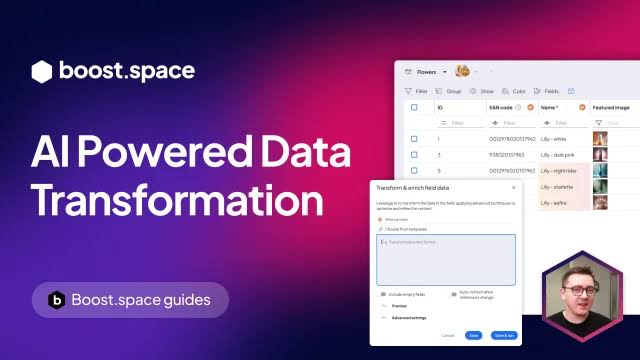
Pricing is one area where readers should be careful because public sources do not all show the same figure. Some 2026 pricing listings show self-serve monthly plans and a free tier, while other software marketplaces list higher business or enterprise starting prices. A February 2026 launch announcement also promoted a limited founder discount with a lower annual Pro entry point, but that campaign had a deadline and should not be treated as normal pricing after the offer period.
ICON POLLS' view is that Boost.space pricing makes the most sense when a team will actually use the platform as a central data layer, not just as a small automation add-on. If a business only needs simple one-step automations, cheaper tools may be enough. But if the team is syncing thousands of records, running AI enrichment, managing product data, or connecting several departments, the cost can be easier to justify.
Before subscribing, check record limits, operations limits, sync frequency, admin seats, AI credits, MCP availability, API access, and onboarding support. Those details matter more than the headline monthly price.
Boost.space v5 Academic
Many users search for Boost.space academic pricing or student access, but ICON POLLS did not find a clear official academic discount page for Boost.space v5 during this review. That does not mean the company cannot support schools, training teams, or university projects, but it means academic buyers should contact sales directly instead of assuming a student plan exists.
For academic use, Boost.space could be useful in business analytics, ecommerce operations, automation training, data management courses, and AI agent workshops. It gives students and researchers a real-world way to understand how messy app data can be unified before AI systems can act on it. The main limitation is that new users may need guidance because Boost.space is more complex than a basic spreadsheet or form builder.
Boost.space v5 Roadmap
Boost.space's 2026 roadmap appears focused on making business data more usable for AI agents and automation builders. Public release notes around v5 mention stronger AI readiness, improved Make.com connection, MCP access, smarter imports, and better system control. Later 2026 release notes also suggest the company is continuing to improve data control and AI-ready workflows.
For users, the roadmap direction is positive. The platform is not only adding more integrations. It is also trying to solve the harder problem: keeping data clean, synced, governed, and ready for AI execution. That is the right direction for teams that want AI agents to do more than answer questions.
Boost.space v5 Integrator
The Boost.space Integrator is one of the product's most important areas. It helps users connect apps, automate data movement, and work with the Make engine. Boost.space says v5 includes a new Boost.space app in the Make Engine with cleaner endpoints, easier actions, and two-way data flow.
This is valuable because many automation problems are really data problems. A Make scenario may work well at first, but it becomes hard to maintain when fields change, records duplicate, or every app has its own format. Boost.space gives those scenarios a central place to read and write records. For agencies and automation consultants, this can reduce spreadsheet dependency and make workflows easier to manage over time.
Boost.space v5 MCP
MCP is one of the biggest reasons Boost.space v5 is getting attention in 2026. MCP stands for Model Context Protocol. It lets AI tools connect to external systems and work with real business data in a more structured way.
Boost.space describes its MCP as a way for AI agents to access live, unified data instead of relying on static exports or copied information. Its Remote MCP Server is designed to remove the need for teams to host their own server. That is useful for businesses that want AI agents to query customer records, analyze orders, enrich products, update fields, or trigger workflows without giving every AI tool direct, uncontrolled access to every app.
The promise is strong, but users should still treat MCP access carefully. Teams need proper permissions, data governance, and testing before allowing AI agents to change business records.
Boost.space v5 User Experience
Boost.space v5 feels built for serious operators, not casual users. The strongest parts of the user experience are the central database idea, the large integration list, two-way sync, AI mapping, and the ability to connect automations to one structured data layer.
The weaker side is the learning curve. Public user reviews often praise the platform's power, support, and ability to centralize data, but some users also mention setup complexity and the need to understand documentation. ICON POLLS agrees with that pattern. Boost.space is not difficult because it is poorly designed. It is difficult because it deals with complex data flows, business records, app mapping, permissions, and automations.
For beginners, the best way to start is with one use case, such as product sync, lead routing, inventory updates, or CRM cleanup. Trying to connect the whole business on day one can feel overwhelming.
Pros and Cons of Boost.space v5
Pros:
1. Strong central data layer for automations and AI agents.
2. Useful for teams already using Make, Zapier, n8n, CRMs, ecommerce tools, and spreadsheets.
3. MCP support makes the platform more relevant for AI agent workflows.
4. Two-way sync can reduce duplicated records and manual updates.
5. Large integration library and clear direction toward AI-ready operations.
6. Good fit for agencies and operations teams handling complex data.
Cons:
1. Learning curve can be steep for beginners.
2. Pricing can be confusing because public listings show different entry points.
3. Smaller teams may not need all the advanced data features.
4. MCP and AI automation require careful permission and governance setup.
5. Best value comes when the business has enough data volume to justify it.
Who Should Use Boost.space v5?
Boost.space v5 is best for teams that need clean, synced data across many tools. Ecommerce businesses can use it for product data, orders, inventory, and customer records. Agencies can use it to build more reliable automation systems for clients. RevOps and marketing teams can use it to reduce data gaps between CRM, email, ads, forms, and reporting tools.
It is also a good match for AI automation builders who want their agents to work with real business context. If your main problem is scattered data, Boost.space is worth testing. If your main need is a simple trigger and action automation, it may be more than you need.
ICON POLLS Verdict: Is Boost.space v5 Worth It in 2026?
Boost.space v5 is worth considering in 2026 for businesses that are serious about automation, AI agents, and unified operational data. It earns an ICON POLLS rating of 4.0 out of 5 because it has a strong product direction, useful MCP positioning, a serious integrations layer, and real value for data-heavy teams.
We did not rate it higher because pricing clarity and beginner friendliness still matter. A platform can be powerful and still require careful onboarding. For the right user, Boost.space v5 can become a core part of the business workflow. For the wrong user, it may feel too advanced for simple automation needs.
Frequently Asked Questions About Boost.space v5 in 2026
1. What is Boost.space v5 used for?
Boost.space v5 is used to centralize, sync, enrich, and manage business data across apps. It helps automations and AI agents work from one shared source instead of scattered spreadsheets and disconnected tools.
2. Is Boost.space v5 an automation tool?
Yes, but it is more than a basic automation tool. It works as a data layer that supports automation platforms, app integrations, AI enrichment, and MCP-powered AI agents.
3. How much does Boost.space v5 cost in 2026?
Public pricing sources in 2026 show different figures depending on plan type, self-serve access, and enterprise level. Users should check the live Boost.space pricing page because plan limits, credits, and offers may change.
4. Does Boost.space v5 have a free plan?
Some 2026 listings mention a free tier or trial, but users should confirm current availability on Boost.space's live pricing page before making a decision.
5. What is Boost.space MCP?
Boost.space MCP is a way for AI agents to access and work with live business data inside Boost.space. It helps agents answer questions, analyze records, and trigger actions using structured company data.
6. Does Boost.space v5 work with Make.com?
Yes. Boost.space v5 places strong focus on Make.com users by giving scenarios a central database layer and cleaner endpoints through the Boost.space app in the Make Engine.
7. What is Boost.space Integrator?
The Integrator is the part of Boost.space that helps users connect apps and move data between systems. It supports the platform's bigger goal of keeping records synced and usable across business tools.
8. Is Boost.space v5 good for ecommerce?
Yes. Ecommerce teams can use Boost.space for product information, customer records, order data, inventory workflows, and AI-ready data enrichment across multiple sales and marketing tools.
9. Is Boost.space v5 good for beginners?
It can work for beginners, but there is a learning curve. New users should start with one simple use case before building a large multi-app system.
10. Does Boost.space v5 have academic pricing?
ICON POLLS did not find a clear official academic discount page for Boost.space v5. Schools, universities, and students should contact Boost.space directly to ask about education options.
11. What are the best Boost.space v5 alternatives?
Common alternatives depend on the use case. For simple automations, users may compare Zapier, Make, and n8n. For databases, they may compare Airtable or Notion. For customer data and analytics, they may compare CDPs or BI tools.
12. Is Boost.space v5 safe for business data?
Boost.space positions itself around secure business data management and public company pages mention compliance and security milestones. Still, every business should review permissions, contracts, data residency, and access controls before storing sensitive records.