Every AI coding tool in 2026 claims to be smarter than the last one. Dropstone 3 at least claims something different. Blankline's editor bills itself as the first multiplayer AI code editor, a place where several humans and several AI agents work on the same project at the same time and share the same memory. In a field crowded with Cursor, Claude Code, GitHub Copilot and Windsurf, that is a real pitch.
The problem is everything around the pitch. Since version 3 launched on February 9, 2026, the desktop app has been parked in maintenance-only mode, the documentation is still thin, and the most impressive numbers come from Blankline itself. Icon Polls scores it 2.2 out of 5. Here is how we got there.
Dropstone 3 on one page
| Detail | What we know |
|---|---|
| Product | Dropstone 3 (v3.0), an AI coding environment |
| Made by | Blankline, a research-focused AI company |
| Base | Chennai, India |
| Company founded | 2024 |
| Version 3 release | February 9, 2026 |
| Engine | D3 Engine (Dynamic Distillation and Deployment) |
| Headline feature | Share Chat, real-time multiplayer coding with AI agents |
| Platforms | Windows, macOS and Linux; the CLI is the main product, the desktop app is maintenance-only |
| Languages | More than 40 |
| Free plan | 50 agent requests a day, open models, Claude CLI access |
| Pro plan | $15 a month, unlimited agent requests, roughly 750 premium requests |
| Teams plan | $75 per user a month, with SSO/SAML and collaboration tools |
| Website | dropstone.io |
| Icon Polls rating | 2.2 out of 5 |
Ten thousand timelines, no outside referee
The D3 Engine is where Blankline puts its ambition. Most assistants predict code along a single path. Dropstone says its Recursive Swarm Architecture simulates more than 10,000 divergent coding timelines at once, prunes the weak ones and hands you the most stable result. A layer called Semantic Entropy Tracking watches how consistent the suggestions are across those timelines and flags the shaky ones, which is the company's answer to hallucinations.
It is a clever story. It is also mostly unverified. Blankline's AGCI benchmark claims a 35% progress score ahead of competitors, but nobody outside the company has confirmed it. Until independent testers get involved, treat the swarm numbers as marketing rather than measurement.
Memory that actually sticks
The part users do vouch for is memory. Dropstone keeps four kinds (episodic, semantic, procedural and associative) and carries your coding habits from one session to the next. Plenty of tools forget you the moment you close the window. Several Dropstone users report that this one genuinely adapts the longer they use it, and that it can refactor across multiple files without losing track of dependencies. That is the strongest practical argument for the product.
The desktop app went quiet
Dropstone began as an Electron desktop IDE for Windows 10/11 and Apple Silicon Macs. Setup meant pointing it at your project root, excluding folders like node_modules and build directories, and waiting for a full analysis. On big codebases, that first scan is slow. The app also offered Horizon Mode, a full-screen, distraction-free view for architectural planning that looks at how complex systems fit together over time.
All of that is now frozen. Blankline has stopped active development on the desktop IDE and moved its effort to a command-line tool. The installers are still there, but no further updates are planned. For a product this young, walking away from the graphical interface is a big call, and anyone who chose Dropstone for a visual editor has reason to feel short-changed.
Fifteen dollars against a moving target
On price alone, Dropstone looks sharp. The free tier's 50 daily agent requests are enough to kick the tyres properly. Pro, at $15 a month, brings unlimited agent requests and about 750 premium ones, and Blankline markets it as roughly twice the usage of Claude Code Pro for $5 less. Teams costs $75 per user a month and adds collaboration features, SSO/SAML and higher limits. Enterprise is priced on request, and you can switch plans whenever you like.
Cheap is only good value if the tool holds up. With a stalled desktop app, limited docs and reported lag on larger projects, $15 a month is a bet on where Dropstone is heading, not a payment for where it is.
Getting it onto your machine
Downloads live at dropstone.io/downloads, with setup guides at docs.dropstone.io. The CLI is the one to pick. It ships as a single statically linked binary per platform, with no Node runtime and no extra packages. Mac users can install it through Homebrew, Windows users get an .exe installer, and the flow is simple: install, sign in, start a chat. Early adopters hit problems with download paths and package availability, though later updates have largely fixed those.
Share Chat is the real idea
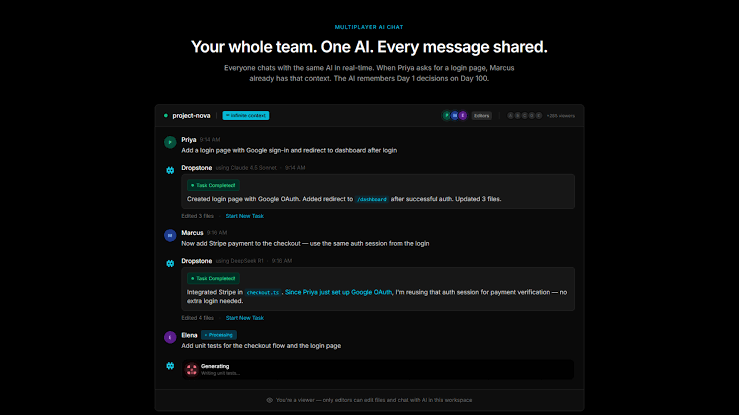
Strip away the benchmarks and Share Chat is what makes Dropstone interesting. You send a link, other people join, and everyone works alongside multiple AI agents with full access to the project's memory and context. No catch-up summaries, no README archaeology. Cursor and Claude Code are largely single-player by comparison.
The execution lags behind the concept, though. Users regularly describe the interface as rough, troubleshooting is painful with so little documentation and community help, and the AI's explanations for its fixes can be too brief, so you still review a lot by hand. For a broader look at where tools like this sit among other tech picks, browse our latest Icon Polls features and vote on what's worth your time.
The company behind it
Blankline was founded in 2024 in Chennai and describes its mission as building safe, capable AI systems for software engineering. Dropstone is its flagship. The company publishes research on its blog about the memory architecture, the D3 Engine and swarm design, and lists careers through dropstone.io/about. It reads like a research-heavy startup, which explains both the bold architecture and the abrupt change of course on the desktop app.
Where the 2.2 comes from
The score is not a verdict on the ideas. Multiplayer coding with shared AI context, and memory that persists between sessions, are both worth paying attention to. The score reflects what a developer gets today: a CLI-first tool with an abandoned desktop sibling, thin documentation, an unpolished interface and headline claims nobody else has checked.
If you enjoy the bleeding edge and live in the terminal anyway, the free tier is a sensible, low-risk way to see whether the memory and Share Chat earn a place in your workflow. If you need something stable and well documented for daily work, the more mature tools are the safer pick right now.
Is Dropstone 3 free?
Yes. The free plan gives you 50 agent requests a day, open models and Claude CLI access. Pro is $15 a month and Teams is $75 per user a month.
Is the desktop app still worth installing?
Only if you accept that it will not be updated. Blankline now develops the CLI, and that is where new features land.
Is it ready for enterprise teams?
It offers self-hosted deployments for air-gapped setups, SSO and SAML on Teams, and routing through local Ollama models for privacy. Given its age, the shortage of independent reviews and the shelved desktop app, most enterprise teams would be wise to wait before relying on it in production.