Voice agents are everywhere right now. Support desks, clinics and sales teams all want to know whether a bot can answer the phone. Most of the platforms selling that answer take a per-minute fee on every call. Dograh does it differently. It's open source, you can run it on your own server, and if you do, the platform itself costs nothing.
That's a good pitch. Whether it holds up depends on who you are and how much setup work you're willing to do.
| Detail | Dograh at a glance |
|---|---|
| Company | Zansat Technologies Pvt Ltd |
| Founded | 2024, in India |
| Founders | YC alumni with previous startup exits |
| What it is | Open-source platform for building voice AI agents |
| Licence | BSD 2-Clause |
| Main product | Drag-and-drop workflow builder for call flows |
| Pricing | Free when self-hosted; managed cloud from $0.01 per minute, plus model and provider costs |
| Code | github.com/dograh-hq/dograh |
| Website and cloud app | www.dograh.com and app.dograh.com |
| Icon Polls rating | 3.0 out of 5 |
Phone calls, built from parts you choose
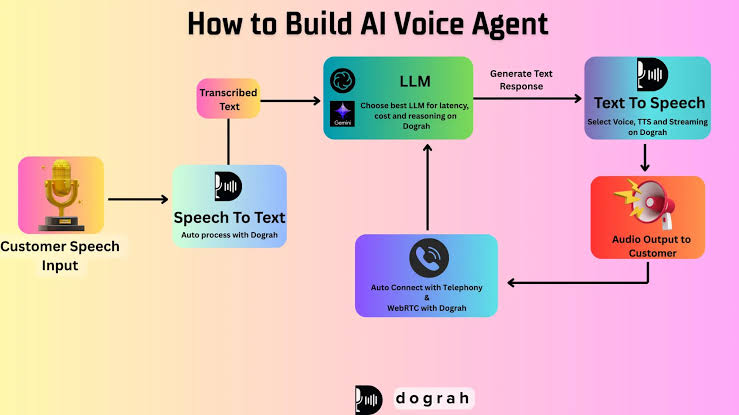
At its core, Dograh helps you build AI agents that make and take phone calls. Typical jobs include appointment booking, customer support, sales qualification and payment reminders. Each live conversation runs through three layers: speech-to-text to hear the caller, a large language model to decide what to say, and text-to-speech to say it.
The design choice that matters most is that you bring your own API keys for every layer. You can use OpenAI, Anthropic or whichever providers you prefer, and you can swap one out later without rebuilding your workflows. Closed platforms like Vapi and Retell are built differently. If you've ever been stuck with one vendor's pricing or one model's quirks, you'll see why that flexibility counts.
The canvas is where you'll spend your time
Most of the daily work happens in a visual builder. You place nodes on a canvas and connect them. One node greets the caller, another asks qualifying questions, another calls an external API, and another hands the call to a human when the bot runs out of answers. You can test an agent directly in the browser using audio or text chat, so the loop of building, testing and adjusting stays short.
Two features stand out. The first is a QA node that reviews the prompts across your workflow and flags likely problems. It sounds minor, but it speeds up the frustrating hunt for why an agent keeps going off-script. The second is MCP server integration, which lets you build and manage agents through natural language from tools like Claude Code, Cursor and Codex. It's a promising idea, but for now it reads more like a developer preview than a finished feature.
Licence, stars and a young community
The BSD 2-Clause licence is permissive and widely understood. It allows commercial use, modification and redistribution with very few conditions. For any business wary of open-source legal fine print, that's reassuring.
Interest grew fast once people noticed the project. By mid-2026 the main repository had passed 1,500 GitHub stars, helped by a May 2026 run on GitHub's trending page that brought in more than 230 stars in one day. Stars only tell you so much, though. The steadier sign is the commit history: updates ship regularly, and the dograh-hq organisation now hosts the core platform plus plugins, a Python SDK and several integrations.
Community activity happens in GitHub Discussions, GitHub Issues and a Slack workspace, and the team appears responsive to outside contributors. The weak spot is documentation. It's split between the repo and the company blog, and anything beyond the basics can mean digging through old threads.
Getting in the door
There are two ways to start. The hosted version at app.dograh.com takes a quick sign-up and drops you straight into the dashboard. There's no guided tour or setup wizard, so newcomers to voice AI may feel a little lost.
Self-hosting runs on Docker. On first startup, Dograh generates API keys automatically, and there's no external authentication layer by default. That's fine for testing. For production, you'll need to add your own access controls, and the documentation on securing multi-user setups could go further. Single sign-on (SSO) is only available on the enterprise tier, which matters more to large organisations than to small teams.
What users keep saying
There aren't many formal reviews on sites like G2 or Capterra yet. Most of the discussion is on Product Hunt, GitHub, Reddit and LinkedIn, mostly from developers and agency founders. The praise is consistent: no platform fees when self-hosting, real savings compared with Vapi or Retell for teams making lots of outbound calls, and a builder that gets a basic agent running quickly.
The complaints are just as consistent. There's no mobile app, the documentation for advanced setups is thin, self-hosting takes real effort to learn, and complex multi-step workflows get messy and hard to debug. Underneath all of it is one recurring point: developers do well with Dograh, but a non-technical business owner would struggle to run it alone.
Built by engineers, for engineers
That point sums up the overall experience. The backend has a strong reputation. Users describe the builder as stable and the call latency as low enough for natural conversation, which fits a founding team with an engineering background. The surface is rougher. Some menus aren't where you'd expect, error messages can be vague, and analytics are basic next to paid competitors.
None of these are fatal. Together, though, they make Dograh feel like an excellent toolkit rather than a finished product.
The ledger
- For it: truly open source under a permissive licence; no platform fees when self-hosted; bring your own speech and language models; frequent updates; a fast visual builder for prototypes; good telephony options.
- Against it: scattered documentation; minimal onboarding; an interface that lacks polish; no mobile app; few formal third-party reviews; SSO only on enterprise plans; a small community.
Our verdict: 3 out of 5
Icon Polls rates Dograh 3.0 out of 5, and that score reflects a real split. If you're a developer or a technical team comfortable with Docker, and per-minute fees are eating into your margins, Dograh deserves a serious trial. The cost savings and model flexibility are genuine advantages, not marketing.
If you want a polished product with guided onboarding, mature documentation and compliance certifications included, it's too early. Check back in a year or choose a paid platform for now. For more reviews and fan-voted rankings across tech and pop culture, browse the latest Icon Polls features and have your say.
Is Dograh actually free?
The self-hosted version has no platform fees or usage limits. You still pay for the services you connect, such as language model APIs and your telephony provider. The managed cloud starts at $0.01 per minute, plus those same model and provider costs.
Can I build an agent without coding?
Simple agents, yes. The drag-and-drop builder covers basic call flows without code. Custom integrations, API calls and complex branching logic still need some technical skill.
Is it suitable for regulated industries?
Self-hosting gives you full control over your data, which appeals to healthcare, finance and legal teams. Security then depends on how well you configure your own environment, and the managed cloud doesn't currently advertise SOC 2 or ISO certifications.