Few open-source AI projects have collected attention like NextChat. The repository passed 88,600 GitHub stars and 59,000 forks by August 2026, which puts it among the most popular tools of its kind. Popularity and momentum are not the same thing, though. Look past the star count and you find a project that still works well but has stopped moving quickly, and that changes who it's really for.
Here is how NextChat looks heading into the last stretch of 2026: what it does well, where it falls short, and whether you should bother setting it up.
The short version
| Product | NextChat (formerly ChatGPT-Next-Web) |
|---|---|
| Websites | nextchat.club / nextnext.chat |
| Source code | github.com/ChatGPTNextWeb/NextChat |
| GitHub stars | 88,600+ (August 2026) |
| Latest version | v2.16.1 (late July 2026) |
| License | MIT, open source |
| Developer | Leizhenpeng / GPTsMotion Tech LLC |
| Launched | 2023 |
| Platforms | Web, Windows, macOS, Linux, iOS, Android |
| Built with | TypeScript, React, Tauri |
| Models | GPT-4, Claude, Gemini, DeepSeek, Ollama and other OpenAI-compatible endpoints |
| Price | Free to self-host; paid SaaS plans at nextchat.club |
| Icon Polls rating | 2.6 / 5 |
A remote control, not a model
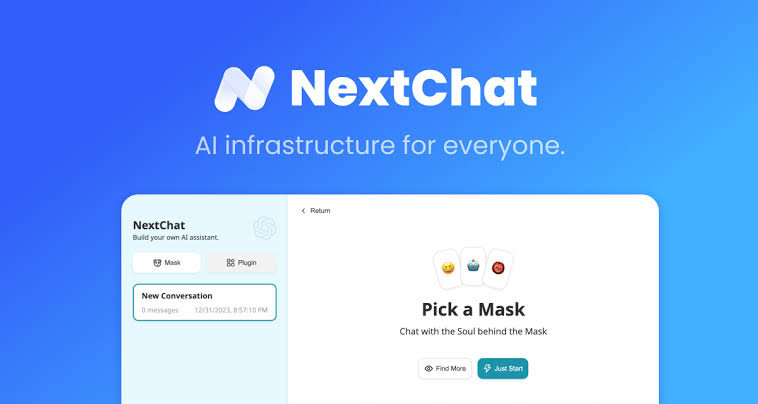
The most common misunderstanding about NextChat is what it actually is. It isn't an AI model and it doesn't compete with ChatGPT or Claude on intelligence. It's a lightweight chat window that sits on top of other people's models. You paste in API keys from OpenAI, Anthropic, Google or another provider, and NextChat gives you one tidy place to talk to all of them.
You can self-host the open-source version on Vercel, run it locally with Docker, or skip the setup entirely and pay for the hosted version at nextchat.club. The self-hosted build keeps conversations stored in your browser, so nothing passes through a NextChat server on the way to your chosen provider. On paper, that's an excellent pitch. In practice, the details matter.
The Windows app: tiny, quick, a little fragile
The desktop app is built with Tauri rather than Electron, and it shows. The installer is roughly 5MB, a fraction of what Electron apps usually weigh. It supports Windows 10 and later, and the interface mirrors the web version closely, so anyone who has used NextChat in a browser will feel at home. Dark mode, markdown and model switching all behave as expected.
The weak spots are stability and updates. Users on the project's GitHub issues page have reported freezes on Windows 11 during long conversation threads, particularly from version 2.15 onward and especially when the auto-compress feature starts summarising older messages. There's also no smooth auto-update: new versions come from the GitHub releases page or a SourceForge mirror, downloaded by hand. For a tool pitched at daily use, that's an odd gap.
There is no login, and that's a choice
New users often go looking for a sign-up page that doesn't exist. The self-hosted version has no accounts at all. Access is controlled by a single access code set as an environment variable when you deploy, and anyone holding that code can use your instance.
For one person, that simplicity is fine. For a team, it's a real limitation: no role-based permissions, no per-user audit logs, no way to cap one colleague's usage. The project documentation mentions enterprise features such as security auditing and conversation tracing, but those sit in the commercial product, not the free one. The iOS app and the nextchat.club service do have conventional logins, with iOS subscriptions tied to your Apple ID.
88,600 stars and a queue nobody is clearing
This is the section that pulls the rating down. By August 2026 the repository had more than 700 open issues, 23 of them tagged as needing help. Bug reports and feature requests from mid 2026 sat unanswered for weeks.
Releases have slowed too. v2.16.1 arrived in late July 2026 with modest changes: a Danish translation, Mistral icon fixes and Claude 3.7 support. There had been no major feature release in 2026 at that point. Community pull requests from May and June, including a Claude 4 compatibility fix and a new API provider, were still waiting to be merged, and the documentation repository hadn't been meaningfully updated since early 2025.
None of that means the project is dead. It means it's in maintenance mode. If you need support for the newest models the week they launch, that matters a lot.
iPhone: clean but quiet
The iOS app, listed as NextChat AI and published by GPTsMotion Tech LLC, needs iOS 17.3 or later and also runs on Apple Silicon Macs. It keeps the bring-your-own-key model and adds in-app subscriptions for people who'd rather not manage keys. The listing says no user data is collected, though it also notes data isn't encrypted, which matters if your chats include anything sensitive.
One detail stood out when the original version of this review was researched: the App Store page didn't have enough ratings to show an overview. For a project with this many GitHub fans, that suggests the mobile audience is small. Reports of the interface describe it as clean and responsive but light on mobile polish, with gestures and phone-specific layouts kept minimal.
Searching the stores is its own hassle. Google Play lists an unrelated random video chat app called NextChat from MeetZone MMC, and another from Servionsoft focused on multilingual messaging. Neither is this tool.
Where it earns its keep
- Speed. Pages load fast and responses stream with little delay. It feels lighter than most rivals.
- Rendering. LaTeX, code blocks and Mermaid diagrams display properly.
- Masks. Saved personas for different jobs are genuinely handy.
- One window, many models. Jumping between GPT-4, Claude, Gemini and DeepSeek beats juggling tabs, and local models via Ollama or LocalAI plug in through OpenAI-compatible endpoints.
Where it costs you
Literally, in one case. Because you supply your own keys, every message is billed to your provider account, and NextChat shows you nothing about it. No usage dashboard, no per-chat estimate, no spending alerts. For anyone on a budget, that's the biggest miss.
Setup is the other barrier. One-click Vercel deployment exists, but environment variables, keys and troubleshooting still assume some technical comfort. Translations across its dozen-plus languages also draw complaints about awkward phrasing.
Who should actually use it
Our 2.6 out of 5 reflects a split verdict. Developers who already self-host and manage API keys will find a fast, flexible, free front end. Everyone else is better served by the official apps from OpenAI, Anthropic or Google, or by alternatives like LobeChat (around 77,000 stars) and McKay Wrigley's Chatbot UI (over 33,000), which come up most often in the same conversations. For more tech and pop culture picks, browse the latest reviews and fan polls on Icon Polls.
Three things people ask
Is NextChat free?
The open-source version is, but you still pay your AI provider per token. The nextchat.club service sells subscriptions; its pricing page returned an error during research, so current prices couldn't be confirmed.
Can I use it without an API key?
Not the self-hosted version. You need at least one key from a supported provider. The paid service and iOS subscriptions may bundle model access.
Is it a replacement for ChatGPT?
Not really. ChatGPT is a complete product with its own model and accounts. NextChat is a front end that gives you more control and choice in exchange for less convenience and polish.