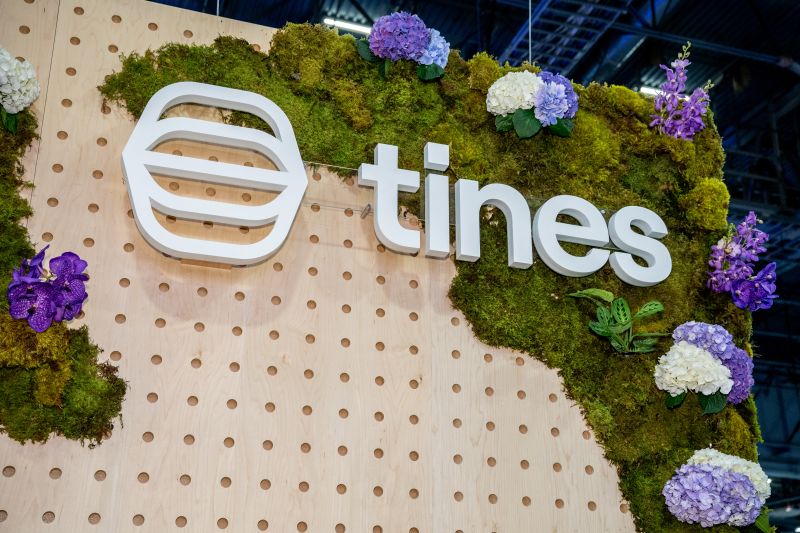
Security teams are drowning in alerts, and the tools meant to help have often been as complicated as the problems they solve. That is the gap Tines walked into. The Dublin company built an automation platform that people who aren't developers can actually use, and it has grown into a business valued at roughly $1 billion. Big names run on it. Its newest feature lets you describe a workflow in plain English and watch it appear.
So is it as good as its reputation? Mostly, yes. But there's a cost, in money and in discipline, that any buyer should understand before signing.
Tines at a glance
| What it is | No-code workflow automation and SOAR platform |
|---|---|
| Founded | 2018 |
| Founders | Eoin Hinchy (CEO) and Thomas Kinsella (CCO) |
| Headquarters | Dublin, Ireland, with an office in Boston, USA |
| Valuation | About $1 billion (reported) |
| Total funding | More than $272 million across several rounds (reported) |
| Key investors | Goldman Sachs, SoftBank, Accel, Felicis Ventures |
| Team size | 500 plus employees in 2026 |
| Notable clients | Coinbase, Canva, Databricks, Reddit, Mars, SAP, Box |
| Compliance | SOC 2 Type II, ISO 27001, ISO 42001, GDPR, CCPA |
| Free option | Yes, the Community Edition |
| Icon Polls rating | 3.5 out of 5 |
Why name a company after a fork?
A tine is one of the pointed prongs on a fork. The word goes back to the Old English "tind", meaning a sharp point or spike, and it has a cousin in the German "Zinne", or pinnacle. The branding logic is simple: several small, sharp points working together to do one job. That is also a fair description of how the product works.
The fork idea carries into the platform in two other ways. Workflows, which Tines calls stories, can branch. A trigger checks a condition and sends data down one path or another, so a single story can treat a low severity alert differently from a critical one. And the shared story library, with more than 1,000 prebuilt templates, works a lot like forking a repository on GitHub. You take someone else's work, adapt it, and run it as your own.
One quick clarification, because it confuses searchers: Tines has nothing to do with Tine, the Norwegian dairy company, or the open source project Tine 2.0.
Seven building blocks, one canvas
The smartest decision Tines made was keeping the toolkit small. Its builder is drag and drop, and its core is seven action types: Webhook, HTTP Request, Event Transform, Trigger, Send to Story, IMAP and Email. That's it. Once those click, you can assemble surprisingly complex automations for phishing triage, incident response, vulnerability management or gathering compliance evidence.
Fewer pieces means a gentler learning curve without much lost in flexibility. Competitors such as Splunk SOAR and Palo Alto Cortex XSOAR are powerful, but they tend to demand more technical skill to set up and maintain. Tines is aimed squarely at teams who want automation running without waiting on engineers.
Story Copilot and the library
Story Copilot, launched in February 2026, lets you type what you want automated and generates a draft workflow. It won't nail every request, but as a starting point it saves real time, especially for newcomers. Pair it with the template library and you rarely start from a blank page. The Pages and Build Apps features also let teams spin up simple internal tools on top of their stories.
Getting in: free accounts, SSO and permissions
Signing up for the Community Edition is quick: an email, a password, and you're through. Enterprise customers log in through their company's single sign on provider, so there is no extra password to manage. Multi factor authentication and role based access controls are supported, which matters once several people are editing automations.
The dashboard is uncluttered. Your stories, the template library and shortcuts to start building sit up front, without layers of settings to wade through.
The bill, and the other risk
Here's where enthusiasm cools. Tines doesn't publish its pricing, and enterprise plans reportedly start at around $50,000 a year. The free Community Edition is useful for a look around but limited enough that serious evaluation is hard. Some users also report that licensing costs climb if you split big workflows into smaller, tidier stories, which is exactly what good practice would encourage.
The second risk is cultural rather than financial. Because building is so easy, people can ship automations nobody has reviewed. One example shared by users involved a company accidentally auto acknowledging any alert containing the word "test". In a security tool, that kind of shortcut is a genuine hole. Tines gives you the power; your team has to supply the change control.
Who's hiring: careers at Tines
With more than 500 staff, Tines is still growing. Listings span engineering, sales, customer success, security and legal, based in Dublin and Boston, with many roles open to remote candidates. Recent openings have included solutions engineers, backend engineers working on AWS GovCloud infrastructure, product security leads and enterprise account executives, a sign of a deliberate push into the US public sector.
The company promotes diversity and inclusion, and its careers page mentions education reimbursement, team socials and full health benefits for US employees. If you're applying for a technical role, the free Tines University certifications are a sensible first step, including an advanced program that takes about three hours.
The founders' own path helps explain the product. Hinchy and Kinsella came from security roles at companies including eBay, DocuSign and PayPal, and Tines feels like a tool built by people who have lived through alert fatigue.
Our verdict: 3.5 out of 5
Based on the platform's documented features, public user feedback and its place in the market, here is how Icon Polls scores Tines:
- Ease of use, 4/5: one of the most approachable builders in security automation, helped further by Story Copilot.
- Features, 4/5: a lean core, a huge template library, AI agent capabilities and strong integrations.
- Pricing and value, 2.5/5: hard to justify for small teams with light needs.
- Support, 4/5: users consistently describe the team as responsive and helpful.
- Transparency, 3/5: hidden pricing is common in enterprise software, but still frustrating.
For a mid sized or large security team, Tines is easy to recommend. For a small shop, start with the free edition and price it carefully. Got opinions on the tools that keep your machines safe? Add your voice in our best antivirus software poll.
Quick answers
Is Tines free?
There is a free Community Edition with limits. Paid tiers are quote based, and enterprise plans reportedly begin around $50,000 a year.
Can non-technical staff really use it?
For most workflows, yes. Complex API work or custom data transformations still benefit from someone with technical experience.
Why does ISO 42001 matter?
It covers AI management systems, so it signals that Tines has had its AI governance formally audited, which is still uncommon among automation platforms.