Ask ChatGPT which project management tool to buy, or which running shoe is best for flat feet, and you get an answer with brand names in it. Nobody paid for that placement. Nobody can see the ranking logic. For marketers, that is a quiet nightmare, and it is exactly the anxiety Atyla was built to sell against.
Launched in early 2026, Atyla calls itself a Generative Engine Optimization (GEO) platform. Strip away the jargon and it does one thing: it watches what AI models say about your brand when people ask questions in your category. The pitch is sharp and the timing is right. Whether the product is worth the money yet is a harder question.
Atyla at a glance
| Detail | What we know |
|---|---|
| Website | atyla.io |
| Category | Generative Engine Optimization (GEO) |
| Launched | 2026 |
| Underlying technology | Senthor.io |
| Co-founder and CEO | Tristan |
| Based in | France |
| AI models tracked | 11, including ChatGPT, Gemini, Perplexity, Claude, Grok and Mistral |
| Starting price | EUR 19 per month (Essential) |
| Free trial | 7 days, no credit card |
| Mobile app | None |
| Public GitHub or API docs | None published |
| Customers (company figure) | 200+ marketing teams |
| Icon Polls rating | 2.8 out of 5 |
The crawler logs are the real selling point
Most GEO tools work the same way. They fire a batch of prompts at chatbots, record what comes back and turn it into a chart. That is useful, but it is guesswork dressed up as measurement.
Atyla has a different card to play. It grew out of Senthor.io, a bot traffic analytics platform built by former lemlist (lempire) executives, which reads real server logs to detect when AI crawlers visit a website. So Atyla can tell you not just what a model says about you, but whether that model's bot actually read your pages. That is a genuine edge, and it is the main reason this tool deserves attention at all.
What you get for your login
The toolkit is focused, some would say narrow:
- Prompt tracking to monitor the specific questions people ask AI chatbots in your space.
- Brand mention monitoring showing how often, and in what context, you appear compared with rivals.
- Competitive analysis laid out in a side by side view.
- GEO audits that flag missing content, pages needing restructuring and topics worth writing about.
- Source tracing that shows where AI models pull from when they mention competitors, such as Reddit threads, Wikipedia entries or industry blogs.
The audit is the strongest piece. Knowing that a competitor keeps getting cited because of one well placed Reddit discussion is the kind of insight that changes a content plan. The weakness is depth. The recommendations lean toward lists of gaps and suggested topics, which reads as a starting point rather than a strategy.
There is also a lot Atyla simply does not try to do. No traditional keyword research, no backlink analysis, no content writing assistant. If your team already runs a conventional SEO suite, Atyla is an add-on, not a replacement.
Browser only, and desktop first
There is nothing to download. You sign up at atyla.io and everything runs in the browser, which is standard for this kind of software. The cost is that there is no offline access and no desktop notifications unless you leave a tab open.
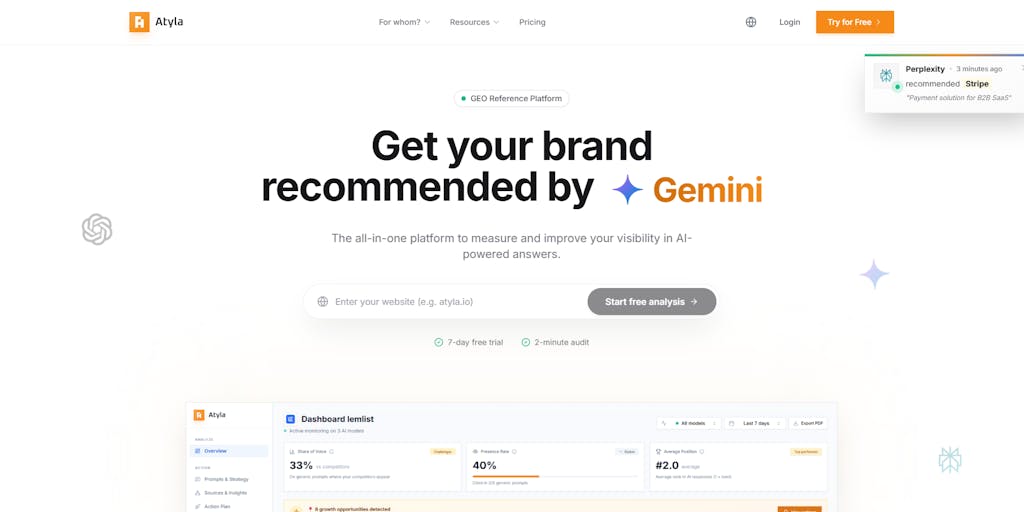
Mobile is the bigger gap. When we first reviewed Atyla in August 2026 there was no iOS or Android app, and we have seen no announcement of one since. The site loads on a phone, but the dashboard is plainly designed for a large screen. For a manager who wants to glance at visibility scores between meetings, even a basic reporting app with alerts would make a real difference.
Closed doors for developers
Atyla has no public GitHub repository and no published API documentation. Closed source is normal for commercial SaaS, so that part is no scandal. The missing API is more frustrating. Technical marketers who want to pipe visibility data into their own dashboards or automate reports have nothing to work with, and that is exactly the audience most likely to champion a young tool like this.
Where the pricing stops making sense
| Plan | Monthly price | Prompts tracked |
|---|---|---|
| Essential | EUR 19 | 15 |
| Starter | EUR 69 | 25 |
| Growth | EUR 149 | 100, plus all AI models |
| Enterprise | Custom | Unlimited, with dedicated account management |
Every plan starts with a 7 day trial, no card required. Billing is monthly or annual through Stripe, and you can cancel any time.
Essential is a fair way to kick the tyres. Fifteen prompts, though, runs out fast if you sell more than one product or serve more than one market. Then comes the awkward step: EUR 50 more a month for just 10 extra prompts. Growth offers much better value per prompt, but EUR 149 is a serious line item for a startup when the output is not always something you can act on the same week.
Clean screens, shaky numbers
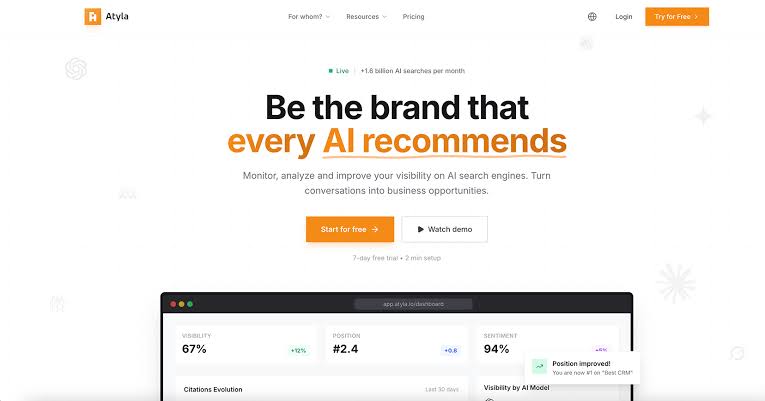
Onboarding is simple. Pick a plan, enter your brand, choose your prompts and let the scans run. The dashboard is uncluttered, the charts are readable and the competitor view makes your position obvious at a glance.
The concern is trust in the data. Some users on Product Hunt have reported visibility scores shifting between back to back scans with no change to the underlying content. Part of that is the nature of AI models, which do not answer the same way twice. But a tool selling measurement needs to explain that variance clearly, and Atyla does not yet do enough of it. Report loading can also drag on larger prompt sets.
Our call: 2.8 out of 5
Atyla is asking the right question at the right moment. AI answers are becoming a front door for buying decisions, and brands that ignore them now will feel it later. The Senthor-backed crawler data is a real differentiator, and the trial costs you nothing.
Right now, though, it behaves more like a monitoring dashboard than an optimization suite. It tells you what AI is saying. It is much less helpful on what to do next. Add the restrictive prompt caps, the missing app and API, and that steep middle tier, and the score lands at 2.8 out of 5.
Enterprise teams with a dedicated GEO budget may find it worth running alongside their existing stack. Freelancers and small businesses should take the trial, learn what they can, and wait for the product to grow up. Curious which sites actually earn a place in your daily routine? Add your pick to our vote on the world's most useful websites.
Before you sign up
How is GEO different from SEO?
SEO aims to rank your pages in search engines like Google. GEO aims to get AI chatbots such as ChatGPT and Gemini to mention, cite and recommend your brand when people ask relevant questions. Atyla covers only the GEO side.
Is there a free version of Atyla?
No permanent free tier exists. You get a 7 day trial without a credit card, after which the cheapest option is Essential at EUR 19 per month.
Do all plans track all 11 AI models?
No. Model access depends on your plan. Every model is included on Growth and Enterprise.