OpenAI has shipped two newer models since GPT-5.4 arrived. GPT-5.5 landed on April 23, 2026, and GPT-5.6 followed on July 9. GPT-5.4 never went away, though. It remains listed in the API at unchanged pricing and sits under Legacy Models for paid ChatGPT users. OpenAI hasn't announced a retirement date. So the useful question in October 2026 isn't whether it's the newest model. It's whether it still earns a place in your workflow or your budget.
Our view: GPT-5.4 is a capable model that many people simply stopped enjoying. Here's why.
The company behind it
| Field | Details |
|---|---|
| Company | OpenAI |
| Founded | December 8, 2015 |
| Headquarters | San Francisco, California, United States |
| CEO | Sam Altman |
| Chairman | Bret Taylor |
| President | Greg Brockman |
| Key products | ChatGPT, GPT-5.4, DALL-E, Sora, Codex, Deep Research |
| Reported valuation (2026) | Approximately $852 billion |
| Reported revenue (2025) | $13.1 billion |
| Employees (2026) | More than 4,500 |
| Structure | Public benefit corporation (privately held) |
| Major investors | Microsoft, SoftBank, Amazon, NVIDIA |
Getting in is easy. Getting the real model costs $20
Signing in is the painless part. You can use ChatGPT on the web or through the iOS and Android apps, and log in with email, Google, Microsoft or Apple.
The friction starts once you're inside. Free users got GPT-5.4 Mini from March 17, but GPT-5.4 Thinking requires at least a Plus subscription at $20 a month. GPT-5.4 Pro is reserved for Pro and Enterprise plans. In other words, you pay before you meet the flagship.
The launch didn't help. Around the March 2026 rollout, enterprise customers reported SSO login failures, and several threads on the OpenAI community forums documented the problem. OpenAI patched it, but paying business users locked out on launch day is a poor first impression.
Then there's the model picker. Thinking, Pro, Mini, legacy models and assorted reasoning modes all share one dropdown. Newer users can genuinely struggle to tell which model they're talking to.
The token bill, line by line
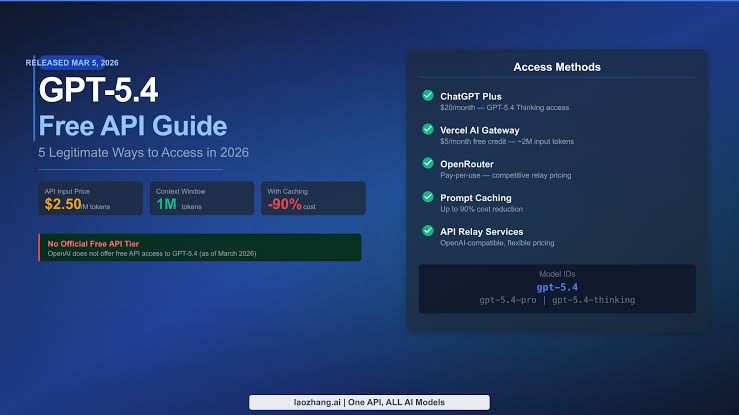
Developers will find GPT-5.4's pricing either reasonable or painful. Which one depends almost entirely on the workload.
- GPT-5.4 standard: $1.25 per million input tokens, $7.50 per million output tokens.
- GPT-5.4 Mini: $0.75 per million input tokens, $4.50 per million output tokens.
- Batch API: half the standard rate, with requests processed asynchronously within 24 hours.
- Prompt caching: a 75 to 90 percent discount on repeated prompt prefixes.
The sore point is the small models. According to reporting from The Decoder, GPT-5.4 Mini and Nano cost about four times as much as their GPT-5 equivalents. Anyone who built a cost model around the older prices had to rebuild it.
The other trap is the context window. The API offers up to 1 million tokens, the largest OpenAI had offered at the time. Requests that go past 272K tokens, however, are billed at roughly double the standard input rate and 1.5 times the output rate. That headline window is real, but using it fully gets expensive fast.
On the consumer side, Plus is $20 a month. Pro comes in two tiers, $100 or $200 a month, and the $200 plan provides 20 times the Plus usage limits along with GPT-5.4 Pro access.
One app, uneven everywhere
ChatGPT runs on iOS, Android, web and desktop, and GPT-5.4 reached all of them. The basics work. The rough edges are mostly in the details that power users care about.
After launch, user reports on Reddit and the OpenAI forums described file uploads and analysis workflows that had been stable before but began failing silently or truncating input. On mobile, people working with long conversations and large attachments reported crashes and lost context. The desktop app is steadier, but it still lacks some features the web version has. Which platform you choose ends up shaping which product you get, and for a service with more than 900 million weekly active users, that inconsistency is hard to excuse.
Strong on paper, frustrating in practice
To be fair to GPT-5.4, OpenAI's claims hold up in controlled settings. Reasoning and coding improved over GPT-5.2. The model also uses fewer tokens to solve the same problems, and it absorbed the coding strengths of GPT-5.3 Codex. ZDNET credited GPT-5.4 Thinking with a lower hallucination rate, which is a meaningful gain.
The same ZDNET coverage, though, criticised the model for not following prompts accurately. That complaint shows up everywhere. Across Reddit, Hacker News and X, users described the same pattern:
- Answers shorter than what GPT-4o, and even GPT-4, used to produce.
- More hedging and disclaimers on routine questions.
- Refusals of prompts that earlier models handled without fuss.
- Code that arrived as skeleton implementations rather than finished work.
- Sycophancy: agreeing with the user instead of pushing back when they were wrong.
- A strange bug that dropped random Arabic words into English replies.
There's a bigger concern behind these complaints. OpenAI serves the largest user base in AI, which puts constant pressure on inference costs. Safety restrictions have tightened with each update. And ChatGPT's routing system, which quietly sends some queries to lighter models, isn't something most users know about. Some people who picked GPT-5.4 reported answers that felt like they came from something smaller. If you select a model, you should get that model.
There's still a way to get good results. Very specific, detailed prompts pull strong work out of GPT-5.4. The trouble is that the out-of-the-box experience slipped, and most people judge a model on how it behaves by default.
The scorecard: 2.9 out of 5
- Login and access, 3.5: fine for most people, dented by launch SSO failures and a crowded model picker.
- API pricing, 2.5: the standard tier is competitive, but the jump in small-model pricing and the long-context surcharges sting.
- App experience, 3.0: works everywhere, yet file upload bugs, menu clutter and mobile instability pull it down.
- Everyday use, 2.5: shorter outputs, more refusals and odd bugs leave the impression that cost efficiency came first.
Overall, GPT-5.4 is technically better than what came before, but it feels worse to use. Where does ChatGPT rank among the sites you rely on? Have your say in our vote for the world's most useful websites.
Three things readers ask
Can I still use GPT-5.4 now that newer models exist?
Yes. It remains in the API at its original pricing and appears under Legacy Models for paid ChatGPT users. OpenAI hasn't set a retirement date, although GPT-5.2 Thinking was scheduled to retire by June 5, 2026, so the end will come eventually.
What separates GPT-5.4 Thinking from GPT-5.4 Pro?
Thinking is the standard reasoning version available to Plus, Team and Pro subscribers. Pro uses more compute per query, performs better on complex reasoning and coding, and is limited to Pro and Enterprise plans. It also uses up your allowance faster.
Does ChatGPT get the full 1 million token context window?
No. The 1 million token window applies to the API. In ChatGPT, the window is smaller and depends on your plan, with Pro and Enterprise getting more room than Plus.