Every AI coding tool promises to write your code. Tessl makes a stranger and more interesting claim: the code shouldn't be the thing you care about at all. Write down what the software should do, keep that document honest, and let the agents do the typing. With $125 million in funding and the founder of Snyk behind it, that idea has had a loud couple of years. The question for 2026 is simpler. Should a working developer actually use it?
Our answer is a qualified maybe, and the qualifications matter. This review is based on Tessl's public documentation, its GitHub presence and what developers have said about it publicly, not on an extended internal trial.
The company on one card
| Legal name | Tessl AI Limited (UK company number 15532364) |
|---|---|
| Founded | 2024 |
| Base | London, United Kingdom |
| Founder and CEO | Guy Podjarny |
| Stage | Private, Series A |
| Total funding | $125 million |
| Reported valuation | Around $750 million (late 2024) |
| Backers | Index Ventures, Accel, GV, Boldstart Ventures |
| Team size | About 59 people (mid 2026) |
| Main product | Agent Enablement Platform with spec driven development |
| Access | Free plan with email sign up; paid professional plans |
| Code | github.com/tesslio, 22 public repositories |
| Icon Polls rating | 3.2 out of 5 |
Why investors paid up so early
The money arrived fast. A $25 million seed round led by Boldstart Ventures and GV came in April 2024. Seven months later, Index Ventures led a $100 million Series A with Accel, GV and Boldstart joining, reportedly valuing a company barely a year old at about $750 million.
That number is mostly a bet on the founder. Podjarny sold his first startup, Blaze, to Akamai and stayed on as CTO there. Then he built Snyk into one of the best known developer security companies of the last decade, valued at around $8 billion. Investors had seen him win developers over once before. Tessl's job is to prove the trick works twice, and with roughly 59 staff, it is still a small team carrying a large valuation.
Specs as the product, code as the output
The core idea is easy to state. In most teams, code comes first and documentation trails behind it, often badly. Tessl flips the order. A spec is a markdown file with YAML frontmatter: a name, a description, the target files, detailed behaviour including error handling, and links to tests. That file becomes the source of truth. When requirements change, you edit the spec and the code is regenerated to match.
When it works, it is genuinely appealing. Intent gets written down. Reviews can focus on what the software should do rather than line by line diffs. AI output becomes more predictable because the model has something concrete to aim at.
The catch is that writing a good spec is a skill, and Tessl's marketing makes it sound easier than it is. Too vague and the generated code wanders. Too precise and you've basically written the program in prose. Finding the middle takes practice.
The January 2026 rebrand
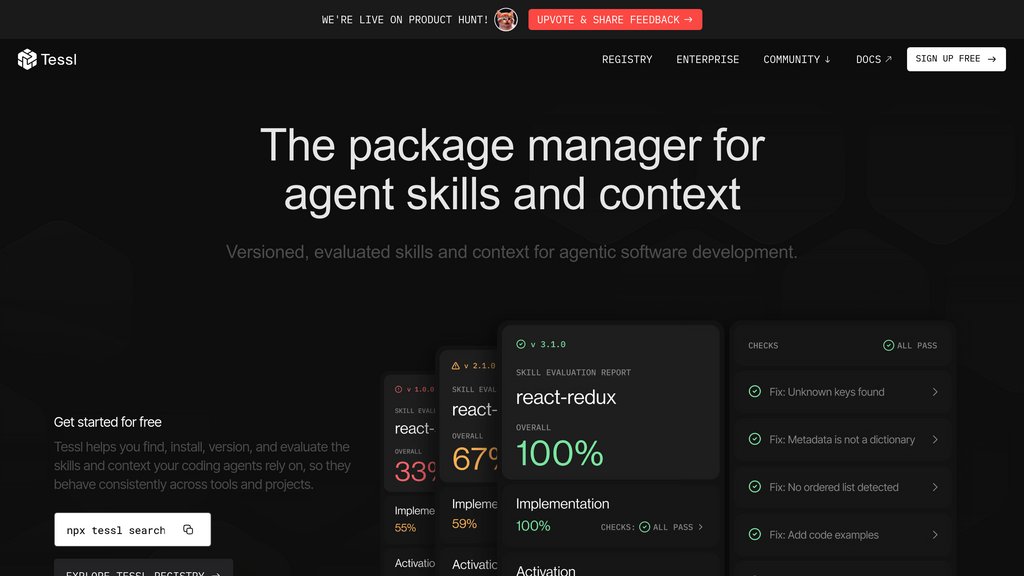
In January 2026 Tessl started calling itself an Agent Enablement Platform. That sounds like a slogan, but it reflects a real shift. Rather than positioning itself mainly as a spec to code generator, Tessl now focuses on feeding context to the AI coding agents developers already use, such as Claude Code and Cursor.
The centrepiece is Skills on Tessl, which works like a package manager for agent knowledge. You install a tile, and your agent learns how to use a particular library, follow a coding standard or respect your team's rules. No special commands or annotations are needed. The spec driven development workflow itself now ships as one of these tiles. Install it and your agent stops leaping straight into code: it asks clarifying questions, drafts a spec, waits for your sign off, then builds.
We think the pivot is smart. Competing with Copilot or Cursor head on would be brutal. Sitting on top of them as a context and governance layer is a far more defensible spot. The weakness is that the story of how specs, skills and tiles fit together still feels unfinished.
The waterfall objection
Tessl has been one of the loudest voices pushing spec driven development into the mainstream, alongside GitHub Spec Kit and AWS Kiro. The pushback from developers is fair. Big upfront specs can start to resemble waterfall planning in nicer clothes. And for a tiny fix, like adding a null check, amending a formal spec feels like a lot of ceremony for very little gain.
None of this kills the idea. It does mean SDD fits some work, such as new features, shared libraries and anything several people will maintain, far better than quick patches. Teams will need to decide where the line sits.
What lives on GitHub
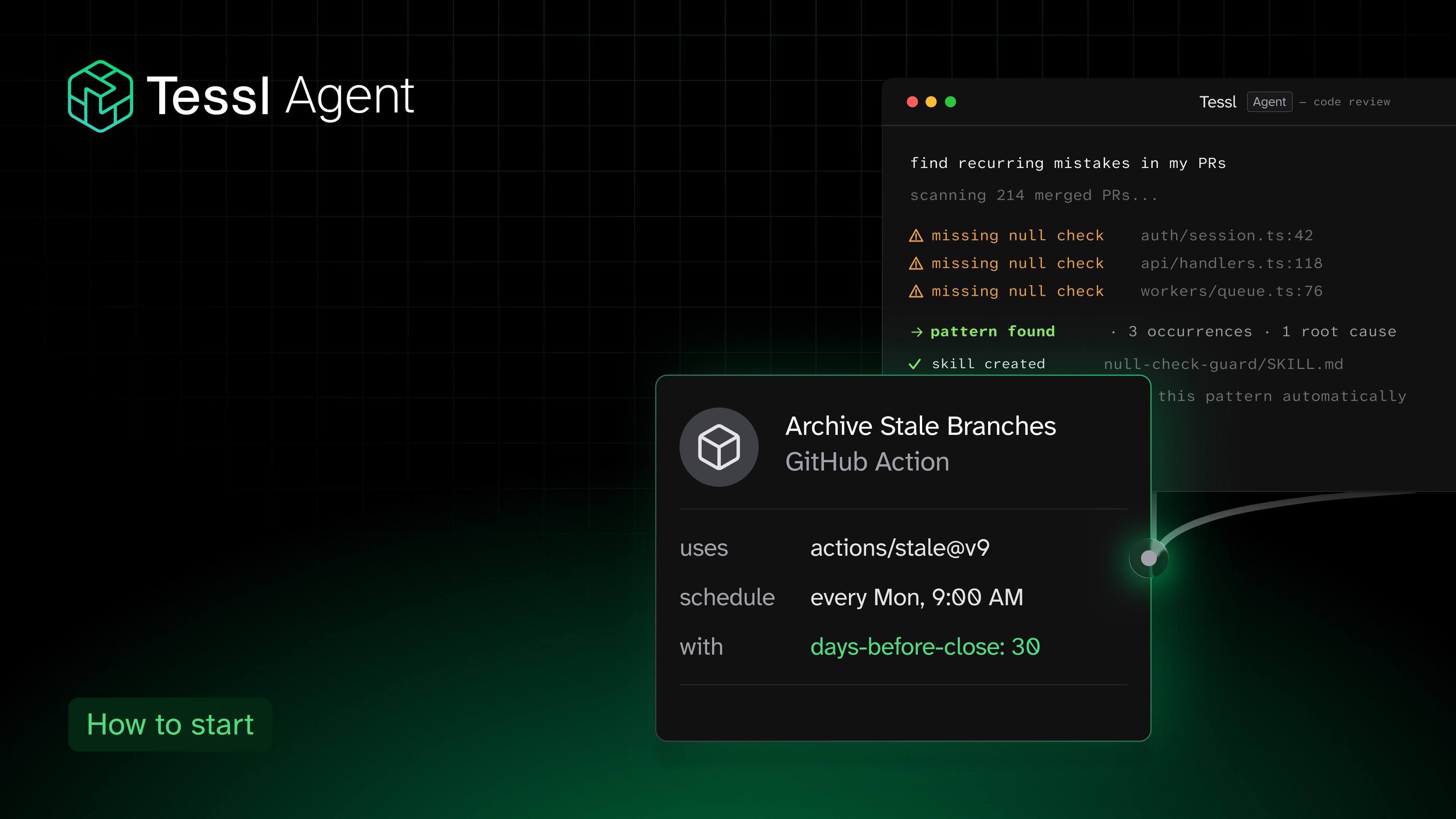
The tesslio organisation holds 22 public repositories, including the CLI, a Homebrew tap, setup actions, plugins, the SDD tile and a GitHub Action that runs Tessl code reviews and posts them as native pull request reviews. Tessl also connects to GitHub and GitLab to roll out shared guidance, such as coding standards and agent instructions, across repositories.
One design choice we like: every change arrives as a pull request you review and merge. Nothing lands in your codebase behind your back. The less flattering detail is community size. The main CLI repo sits at around 40 stars, modest for a company this well funded, and the wider ecosystem, including a hackathon project from a Tessl and Anthropic collaboration, is still thin.
Living with it day to day
Signing up takes minutes. You need a valid email, you must be a human aged 13 or over, and the free plan is available straight away. From there you install the CLI, add an API token from your workspace and start pulling in tiles. The documentation at docs.tessl.io is well organised for the core workflows.
The rough edges show up around it. Newcomers to spec driven thinking get little hand holding. The free tier is tight enough that judging the platform's real value is hard without paying. Documentation for the newer skills features feels incomplete. And the web interface is clearly secondary to the terminal, which leaves managers and less technical teammates on the outside. This is a tool built by engineers for engineers. That suits its audience, but it caps how far it can spread.
Tessl's credibility signals are real, too. Sifted ranked it number 2 in its EU B2B SaaS Rising 100 and number 20 in its AI 100 in 2025, and Podjarny's regular LinkedIn posts are the best place to follow product changes. If you enjoy arguing about which tech firms actually deserve the hype, cast your vote for the best computer companies on Icon Polls.
Why we land on 3.2
The vision is sharp, the founder is proven and the move toward agent enablement shows good strategic instincts. Against that: a pivot only months old, messaging still settling, a stingy free tier and a small community. For teams already deep into AI coding agents, Tessl is worth a serious look now. Everyone else can reasonably wait six to twelve months and see whether the pieces come together.
Three questions developers ask
Does Tessl replace Cursor or Copilot?
No. Those tools help you write code as you go. Tessl sits above agents like Claude Code and Cursor, giving them specs, skills and rules so their output is more consistent.
Can I use it for free?
Yes, there is a free plan with limited features and usage. Teams rolling it out across many repositories will likely need a paid plan.
Is the spec driven approach still central after the pivot?
It is still there, but now as one installable tile within a broader platform for guiding AI agents rather than the whole product.