That is the quiet shift of 2026. Artificial intelligence stopped being the thing agents talked about at conferences and became the thing running in the background of their business. A survey released in February 2026 by Realtors Property Resource found that 82 percent of agents now use AI in some form, up from 68 percent in the National Association of Realtors' 2025 technology survey and roughly 15 percent two years before that. Time savings drive most of it. Around seven in ten agents name it as the main benefit, and about a third say the software hands back more than four hours a week.
Here is the uncomfortable part. Only a small minority of those same agents describe the impact on their business as significant. Adoption is close to universal. Results are not. The difference almost always comes down to what the software was bought to do.
Two jobs eat an agent's week, and neither is glamorous: writing the listing, and chasing the lead. The first decides whether a buyer stops scrolling. The second decides whether the lead you already paid for ends up transacting with you or with the agent who answered faster. The tools below are ranked on how well they handle those two jobs specifically, not on how many features fit on a slide.
Reasonable people will order this list differently, and the right pick depends heavily on lead volume and whether you work solo or on a team. Prices move constantly and several vendors hide theirs behind a demo request, so treat every figure here as a budgeting anchor rather than a quote.
At a Glance: The 2026 Shortlist
|
# |
Tool |
Best for |
Core AI strength |
Approx. cost |
Watch out for |
|---|---|---|---|---|---|
|
1 |
Lofty (AOS) |
Teams wanting one system |
Agentic follow-up, seller intent, listing content |
From about $449/mo |
Learning curve; price climbs fast |
|
2 |
Follow Up Boss |
Teams with mixed lead sources |
Lead routing, reply drafting, call summaries |
From $69/user/mo |
AI is assistive, not autonomous |
|
3 |
ChatGPT / Claude |
Every agent, day one |
Listing copy, emails, market summaries, research |
About $20 to $30/mo |
No memory of your business |
|
4 |
Ylopo (raiya) |
Teams with real ad budgets |
Paid lead gen plus AI text and voice nurture |
About $295 to $500/mo plus setup and ads |
No built-in CRM, so budget for one |
|
5 |
Structurely |
High-volume internet leads |
Human-sounding AI ISA over long cycles |
$499/mo plus per-action credits |
Repriced in 2026; run the math |
|
6 |
Fello |
Reviving a cold database |
Predictive seller signals, autonomous outreach |
Quote only |
Best value with a large database |
|
7 |
Rechat (Lucy) |
Brokerages and busy listing agents |
Voice-driven marketing and CRM actions |
Quote only |
Sold mainly at brokerage level |
|
8 |
Listing Copy AI |
Listing agents who publish often |
MLS-ready copy with fair housing screening |
From about $19/mo |
Narrow scope by design |
|
9 |
Write.Homes |
Multilingual and international markets |
Real estate trained copy in many languages |
Free trial, paid tiers |
Lighter on follow-up features |
|
10 |
Epique AI |
Solo agents on a budget |
Free descriptions, bios, social captions |
Free tier available |
Output needs more editing |
1. Lofty
Lofty, the platform formerly known as Chime, has spent 2026 making the loudest argument in the category. Its agentic AI operating system is built on the premise that software should act rather than wait to be prompted. In April the company launched Homeowner Agent, which watches contacts already sitting in an agent's database, reads the signals that suggest someone is drifting toward a sale, and nurtures them with personalised equity and market updates until they raise a hand. It sorts a database into likely sellers, absentee owners and pre-foreclosure prospects, which is exactly the work most agents never get around to.
At Inman Connect San Diego in late July, Lofty followed with Cowork, an AI workspace, and House.ai, a buyer readiness tool aimed at the moment a consumer discovers they cannot yet afford what they are touring. Pricing starts around $449 a month and can approach four figures for larger teams, so this is not a casual purchase. But no competitor currently covers listing content, nurture and pipeline creation with the same level of automation.
2. Follow Up Boss

Follow Up Boss is the CRM that top-producing teams keep choosing, and its AI is deliberately unshowy. It routes leads, scores them on behaviour rather than form fills, drafts replies inside the inbox, summarises call history and suggests the next action. With published pricing from $69 per user per month, no contract, and integrations with hundreds of lead sources including Zillow and Realtor.com, it remains the pragmatic default.
What makes it rank this high in 2026 is its openness. Because the API is genuinely usable, teams bolt on their own AI layers or third-party assistants and get something close to a bespoke system without leaving the platform they already trained everyone on. The trade-off is honesty about scope: Follow Up Boss helps you follow up faster, it does not hold a months-long conversation with a lead on your behalf.
3. ChatGPT and Claude

The general assistants belong on any serious list, because they are still the fastest way to turn a bullet list of property features into publishable copy. Give either one a decent prompt with square footage, finishes, neighbourhood context and a target buyer, and you will have MLS remarks, a shorter portal version, an Instagram caption and a buyer email in less time than it takes to find the listing photos. Both handle market summaries, objection scripts and follow-up sequences equally well, and paid tiers cost about the price of two coffees a week.
The limitation is real and worth stating plainly. These models know nothing about your business unless you tell them, and they were trained on decades of listing archives that contain language no agent should publish today. Phrases like “perfect for families” or references to nearby places of worship sail straight past a general model. That is a fair housing exposure, and it sits with the listing agent, not the software.
4. Ylopo

Ylopo is the choice for teams whose problem is volume rather than organisation. It runs Facebook and Google advertising, builds the IDX site, then puts its AI assistant raiya on top to text and call new leads before they cool. Estimates place the platform between roughly $295 and $500 a month, with setup fees commonly quoted at $1,000 to $2,000 and AI voice or text modules adding around $100 each. There is no native CRM, so most teams pair it with Follow Up Boss and budget accordingly.
The reason it works is unromantic arithmetic. A large share of buyers hire the first agent who responds, and paid leads decay within minutes. Ylopo's value is not clever copy, it is that the first touch happens at all, at two in the morning, on a Sunday, while you are showing property.
5. Structurely

Structurely built the category. Its AI inside sales assistant texts leads within seconds, qualifies them, handles the standard objections and keeps following up for a year or more before handing over a warm conversation. For teams processing a few hundred internet leads a month, that persistence is worth real money.
Two developments changed the calculus this year. CapStone Holdings acquired the company in January, and in July Structurely moved to a credit model: $499 a month on the Team plan plus roughly eight cents per action, with a $2,000 onboarding fee and a premium for month-to-month billing. One credit covers a single SMS reply, ten seconds of call time or two emails, and a chatty qualifying conversation burns through a dozen or more before the lead is even scored. It is still one of the most convincing AI conversationalists in real estate. It is no longer the obvious pick for a solo agent, and anyone renewing should price the new model against their actual message volume.
6. Fello

Most of an experienced agent's business should come from repeat clients and referrals, yet most databases sit untouched. Fello, used by around 3,000 teams, exists to fix that. It syncs a CRM, enriches it with property and equity data, then markets home value and cash offer messaging on the agent's behalf, surfacing homeowners who are quietly thinking about moving.
In May the company introduced Felix, an AI agent that calls and texts those contacts on its own, qualifies them, and hands them to a human while the prospect is still on the line. Fello's own chief executive was candid about the problem it solves: teams buy expensive leads and then cannot get agents to pick up the phone. If your bottleneck is a neglected database rather than a shortage of names, this is where the money goes furthest.
7. Rechat

Rechat's assistant Lucy is the most interesting bet on interface in the industry right now. Rather than another dashboard, Lucy responds to natural language and, increasingly, to voice. Agents ask her to draft listing copy, spin up a branded property microsite, send a market report, build a CMA or update a CRM record, all from a phone between appointments. The company launched a summer advertising campaign built entirely around that idea, arguing that agents were never going to type their way through a day spent in cars and open houses.
Rechat opened its platform to brokerage developers in June, a sign it intends to be infrastructure rather than a point solution. It is typically bought at brokerage level, which puts it out of reach for many solo agents, but for a listing-heavy business with marketing standards to maintain it is unusually well designed.
8. Listing Copy AI

Purpose-built listing writers earn their subscription in one specific way: compliance. Listing Copy AI, priced from around $19 a month, generates MLS-ready descriptions from property details and screens the output for language that could breach the Fair Housing Act, flagging problems and proposing alternatives before publication. It also produces the variants agents actually need, including a portal-length version, a social caption and an email blurb, from a single input.
It will not run your pipeline and does not pretend to. For an agent listing five or more properties a month, the combination of speed, MLS formatting discipline and an automated compliance pass makes it the safest of the copy tools. As every vendor in the category concedes, automated screening catches known patterns, not every phrasing, so the ninety-second human read remains non-negotiable.
9. Write.Homes

Write.Homes is trained specifically on real estate language, which shows in vocabulary. It reaches for the terms buyers actually search, primary suite, open concept, cul-de-sac lot, instead of the generic enthusiasm a general model defaults to. Beyond descriptions it produces listing emails, social posts and campaign copy from the same property brief.
Its strongest differentiator is multilingual output, which matters more than it used to. In markets with significant international buyer activity or large bilingual communities, an agent who can publish the same listing convincingly in two languages has an edge that costs almost nothing to acquire. It is a content tool rather than a follow-up engine, so treat it as one component of a stack.
10. Epique AI
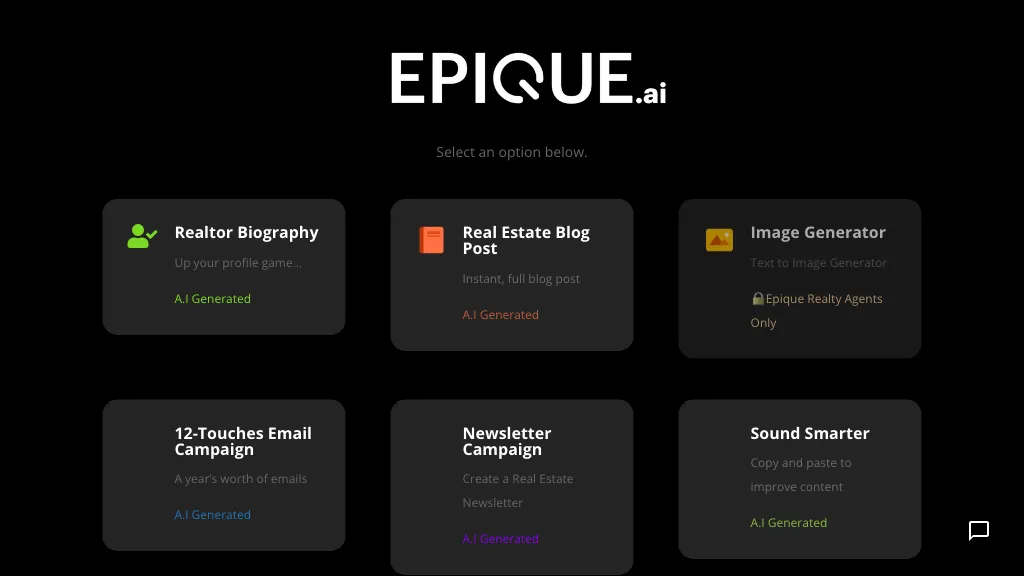
Epique earns its place on economics. Its free tier covers property descriptions, agent bios, social captions and blog content, which is genuinely enough for a newer agent trying to look established without a marketing budget. The output needs more editing than the paid alternatives and the tone can drift toward the generic, but the barrier to entry is effectively zero.
For agents still deciding whether AI belongs in their business at all, this is a sensible place to test the premise before committing to a platform that bills annually.