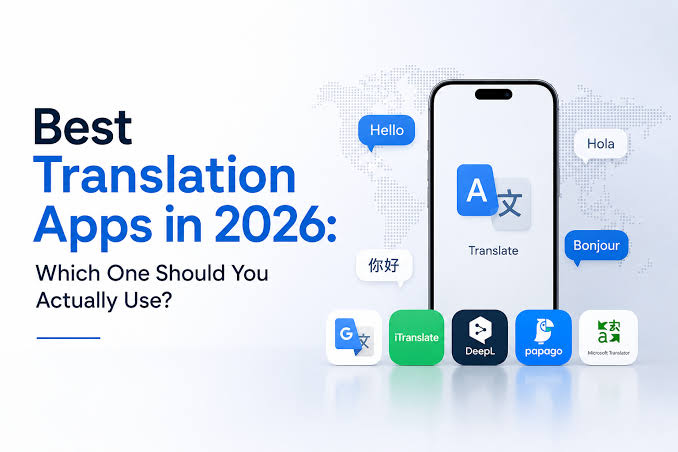
The moment you need a translation app is rarely the moment you have good signal. It happens on a regional train between Lyon and Geneva, in a pharmacy in Dar es Salaam, at a ticket machine in a Kraków station with your roaming data quietly eating your budget. An app that only works online is a fair-weather friend.
So this list judges apps on one question first: what still works when the bars disappear? For a trip that crosses both Europe and Africa, the answer matters more than usual, because African language support is where most apps get thin.
The Ten, Side by Side
| App | Pricing | Platforms | Offline languages | Main modes |
|---|---|---|---|---|
| Google Translate | Free | iOS, Android, Web | 70+ | Text, camera, voice, conversation |
| Microsoft Translator | Free | iOS, Android, Windows | 44 | Text, camera, voice, group chat |
| Apple Translate | Free (Apple devices) | iOS, macOS | 20+ | Text, voice, camera, conversation |
| Lingvanex | Freemium | iOS, Android, Windows, macOS | 91 | Text, voice, camera |
| Talk & Translate | Freemium | iOS, Android | 100+ | Text, voice, camera, AR |
| iTranslate | Premium (about $5.99 a month) | iOS, Android | 40+ | Text, voice, camera, keyboard |
| Speak & Translate | Freemium | iOS, Android | 54 voice, 117 text | Text, voice |
| Yandex Translate | Free | iOS, Android, Web | 60+ | Text, camera, voice |
| Naver Papago | Free | iOS, Android | 14 | Text, voice, image, handwriting |
| DeepL | Freemium | iOS, Android, Web, Desktop | None (online only) | Text, documents |
Prices and language counts shift with app updates, so check the store listing before you rely on a figure.
1. Google Translate: The Default, Earned Honestly
Google supports 249 languages online and more than 70 offline, and that offline list is what wins it the top spot. It covers French, Arabic, Portuguese and every major European language, but also Swahili, Amharic, Hausa, Yoruba, Zulu and Afrikaans. Nobody else on this list matches that spread across both continents.
Instant Camera overlays translations on a menu or timetable without a connection, and conversation mode works offline too. The weakness is polish. Formal text comes out clunky, and several African packs are noticeably rougher than the European ones. Still, for zero cost, it's the app to install first.
2. Microsoft Translator: Built for the Whole Group
This is the most underrated app here. Its multi-device conversation mode lets up to 100 people join a translated chat with a shared code, each reading in their own language. For tour groups or multilingual families, that's genuinely useful.
Offline packs cover 44 languages, and output for German, French, Italian and Spanish often reads more naturally than Google's. A locally stored phrasebook handles food, directions and medical situations. It's all free. African coverage is the gap.
3. Apple Translate: Private by Default
Apple processes translations on the device, so nothing leaves your phone. It's built into iOS and macOS, with no account and no ads. Offline packs cover more than 20 languages, including Arabic, French, German, Italian, Portuguese, Russian and Spanish, and quality inside that range is excellent. Outside it, especially for African languages, there's very little. iPhone users only.
4. Lingvanex: Reach Over Reputation
With 91 offline languages, Lingvanex has the widest offline catalogue in this group, which matters if you're heading to the Baltics, Central Asia or parts of sub-Saharan Africa. Core offline text translation is free; extras sit behind a paywall. Accuracy on French, German and Spanish is solid but less nuanced than Google or DeepL. You install it for coverage, not elegance.
5. Talk & Translate: Conversation First

Talk & Translate aims at context rather than literal substitution, which helps with idioms and casual speech across its 100+ languages. The AR mode overlays translations on signs and menus in your camera view. The catch: full offline voice, text and photo translation requires the premium subscription. On a short trip, the free tier may be enough. On a long one, weigh the cost.
6. iTranslate: Polished, but You Pay
iTranslate has one of the cleanest interfaces in the category, and its keyboard lets you translate inside any app. Offline packs cover more than 40 languages. But offline mode needs a subscription of roughly $5.99 a month, which is hard to justify when Google and Microsoft give it away. It's for people who value consistency and design enough to pay for them.
7. Speak & Translate: Keep It Simple
A voice-first app with offline voice in 54 languages and text in 117. It handles structured exchanges well: hotel check-ins, pharmacies, ordering dinner. Speak clearly and at a steady pace; strong accents can trip it up. Arabic and Swahili are included, though African depth falls short of Google. Its stripped-back design suits travellers who find busier apps overwhelming.
8. Yandex Translate: The Slavic Specialist
For Russian and other Slavic languages, Yandex often beats the big American names, which is a real asset across Eastern Europe and Central Asia, where Russian still works as a common language. Offline packs for more than 60 languages are free. Some travellers will be uneasy using a Russian-built app, and availability varies by region. On technical merit alone, it's strong.
9. Naver Papago: Small List, Sharp Results
Only 14 languages, but Korean, Japanese, Chinese, French, German, Spanish, Russian, Italian and Arabic are handled precisely. Image translation is excellent, and handwriting input is a nice extra. It's a specialist pick, mainly for itineraries that also take in East Asia.
10. DeepL: The Honest Exception

DeepL doesn't work offline. Every translation needs a connection, which is exactly the problem this list is about. It earns a place anyway because, when you do have Wi-Fi, it produces the most natural translations here, especially between European languages. Use it in the hotel to draft an important message, not at the ticket barrier.
The Practical Setup
No single app covers everything. A sensible kit looks like this:
- Google Translate as the base, with packs downloaded for every country on your route before you leave.
- Microsoft Translator if you're travelling in a group or mostly in Western Europe.
- Lingvanex or Yandex if your route goes off the main tourist corridors or east.
- DeepL for anything that has to read well, saved for when you're online.
Download language packs on home Wi-Fi; they're large, and hotel connections are unreliable. And think about which languages actually carry you furthest across two continents. French, Arabic and Portuguese do a lot of work in Africa, Russian in the east. If you have opinions on that, vote in our poll on the most powerful languages in the world.